Rye-wheat bread 60/40
Rye-wheat · pan · lean
The first rye-track lesson: a simple 60/40 rye-wheat control loaf on one rye starter, without malt, spices, or scald.
Live timing needs JavaScript enabled.
Calculated for the current time; the worksheet lets you set any start.
Recipe
Current recipe
For baking now: the final working formula, ingredients, steps, and baking worksheet.
Taste & texture
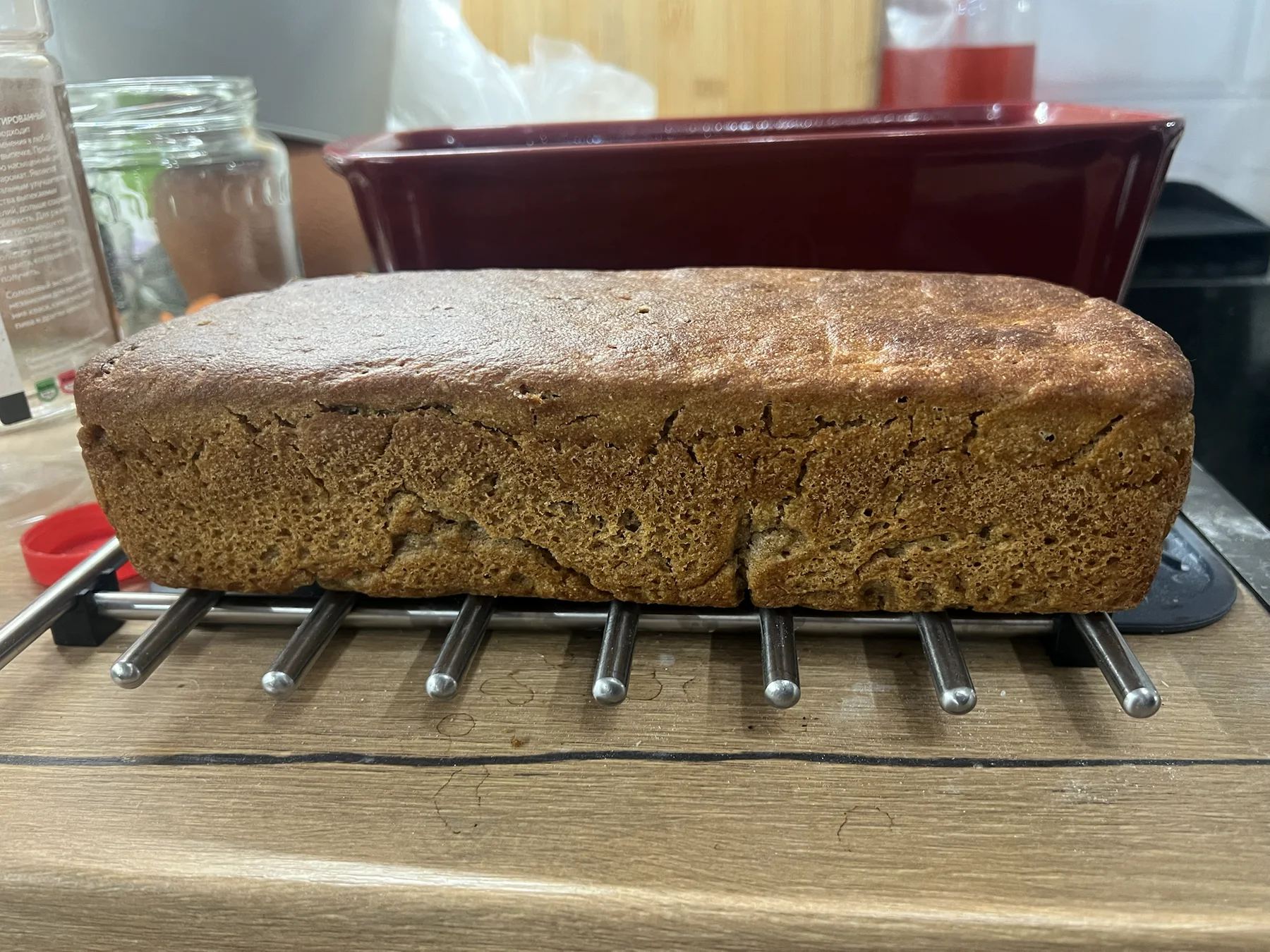
The crumb is dense, moist, and slightly chewy — compact rather than open, held together by pentosans and gelatinized starch rather than gluten. Flavor is earthy and mildly tangy from the rye sourdough, with a gentle nutty, whole-grain note and no sharpness (no malt, spices, or caraway in this formula). The crust softens as the loaf rests. Keeping quality is excellent: rye retains moisture well, and the loaf stays moist for days. The full flavor is only readable after the required 12-24 h crumb rest.
As described by: Zeb Bakes: The 60/40 German Rye Bread Revisited , King Arthur Baking: Explore the Flavors and Textures of Rye
Baking worksheet
Good to know
Why is this the next control loaf?
It removes malt, spices, and scald, making starter activity, acidity, proofing, and crumb easier to diagnose.
What if the crumb is gummy?
First diagnose starter activity, proofing, and internal temperature instead of automatically adding flour.
What if the flavor is bland?
Check starter maturity and post-bake bread maturation time.
A 60/40 rye-wheat is a simple pan loaf on a single rye starter, without malt, spices, or scald. It is the plainest way to bake mostly-rye bread: enough wheat flour for a little lift, but not so much that the dough stops behaving like rye. This is the bread to learn rye logic on before adding the colour, sweetness, and aromatics of a Borodinsky.
How This Bread Is Baked Around the World
Mixed rye-wheat bread is the everyday loaf across a wide rye belt that runs from Germany and the Baltics through Poland and into Russia and Ukraine. Where wheat grows poorly and the climate is cold and damp, rye was historically the reliable grain, and a 50/50 to 70/30 rye-to-wheat ratio is the classic balance: enough rye for the dense, moist, sour character people there expect, enough wheat for a loaf that still rises in a pan.
The reasons are the same everywhere the bread is baked. Rye has almost no bread-making gluten, so the loaf is built on a sourdough rather than commercial yeast alone — the acidity is not just flavour, it controls rye’s aggressive starch-digesting enzymes so the crumb sets instead of staying sticky. Bakers proof it in a tin because the slack rye paste cannot hold a free-standing shape, bake it hard and long to drive the centre past doneness, and then make a rule of waiting a day before slicing. In Germany this family is the everyday Mischbrot and Roggenmischbrot; in Russia and the post-Soviet space the same 60/40 idea underlies the plain “grey” table breads sold as stolovy or darnitsky. The proportions and the spicing shift by region, but the engineering — sour starter, pan support, full bake, long rest — does not.
Theory
Rye dough should not be judged like wheat dough. Gluten structure matters less; acidity, starch, pentosans, water binding, pan rise, internal temperature, and post-bake crumb rest matter more. Stickiness is not automatic evidence for adding flour, and dense crumb is not automatic evidence for adding water.
Full course map: Bread curriculum.
What Holds Rye Crumb
In wheat bread, gluten can carry much of the gas structure. In rye bread, especially at 60% rye, the structure is more dependent on gelatinized starch, pentosans/arabinoxylans, acidity, and the pan. The dough can be sticky and paste-like even when hydration is correct — that is normal rye behaviour, not a sign the formula is wrong.
Sourdough and Acidity
Rye sourdough is not only a gas source. Acidity helps control enzyme activity in rye dough and supports a cleaner crumb. A weak or exhausted starter can still smell sour, but it may not provide enough lift or a stable proof.
Use the starter near peak: domed or just beginning to recede, with side bubbles and a clean rye-fruity aroma. A sharp vinegar note, heavy alcohol, or a long collapse means the timing should be recorded as a process fault, not hidden in the final result.
Pan Proofing
This is a pan loaf because rye paste needs support. Proofing is ready when the dough has risen about 1.6–1.8x, the surface looks alive, and small cracks or broken bubbles appear. Time is only an estimate because starter strength and kitchen temperature move the schedule.
Underproofing gives a tight heavy loaf with limited expansion. Overproofing gives a weak top, large ruptures, sour heaviness, and possible collapse. If the dough reaches the target height early, bake early.
Why Not Slice Immediately
Rye crumb keeps setting after the loaf leaves the oven. A hot slice can look gummy even when the loaf is baked correctly. The learning conclusion should come after 12–24 h, with notes on knife stickiness, moisture, acidity, density, and aftertaste.
Theory Sources
- King Arthur Baking: 5 tips for making rye bread — practical rye-bread handling and structure.
- Sourdough Bread Quality: Facts and Factors — review of sourdough, acidity, fermentation, and bread quality.
- Arabinoxylans as Functional Food Ingredients: A Review — review of water binding and functionality of arabinoxylans/pentosans.
Home Adaptation
This is a home-scale rye control loaf. It needs a pan, scale, probe thermometer, starter jar, and a 12–24 h crumb rest. A pH meter can help later, but the bread can run on starter timing, aroma, peak, pan rise, surface signs, internal temperature, and rested crumb.
The main home rule is not to fix sticky rye dough by adding flour automatically. First diagnose gas, acidity, pan rise, and full baking.
If Something Goes Wrong
- Sticky, paste-like dough → normal for 60% rye; check the rye share and mix only to homogeneity, do not add wheat flour.
- Dense, heavy crumb → check starter activity, proofing, a full bake to 98 °C, and the slicing time before touching the water.
- Knife sticks when slicing → usually too little rest or an underbaked centre; confirm 98 °C internal and wait the full 12–24 h.
- Collapsed or weak top → overproofing or weak acidity; bake earlier next time and use a riper starter.
- Bland flavour → starter not mature enough, or the loaf was sliced too soon for the aroma to develop.
Ingredients
Change any amount — the rest rescale by the bread’s formula.
| Component | Grams | Baker's % |
|---|---|---|
| Active rye starter, 100% hydration | g | 34% |
| Rye flour in final dough | g | 43% |
| Wheat flour in final dough | g | 40% |
| Water in final dough | g | 61% |
| Salt | g | 2% |
Preferments, scalds, and old dough are shown as prepared components; their composition is listed in the row details and worksheet.
Ingredient details
Active rye starter, 100% hydration
- Formula contribution
- contains 85 g rye flour and 85 g water
- State
- use at peak: dome, side bubbles, clean rye-fruity aroma
- If refrigerated 3–4 days
- 1–2 refreshments may be enough
- If refrigerated 7–10 days or more
- use three refreshes: 1:2:2 → 1:3:3 → 20+85+85; use 170 g in the dough and keep 15–20 g as reserve
Rye flour in final dough
- Total rye flour
- 300 g including starter flour, 60% of total flour
Wheat flour in final dough
- Brand the author uses
- MukaMuka 13.5% protein (mukamuka.ru)
- Alternatives
- Aleyna Vivapol 12-13%, Makfa premium
Water in final dough
- Total water
- 390 g including starter water, 78% hydration
- Temperature
- room temperature; record final dough temperature
- Brand the author uses
- Tap water through Barrier Iron x2 filter
- Alternatives
- any filtered or bottled drinking water
Salt
- If coarse
- dissolve in water or grind finer
- Brand the author uses
- Pink Himalayan salt
- Alternatives
- sea or table salt (avoid iodized)
Conditions and equipment
Conditions
- Recipe role
- 60/40 control bake before more complex rye breads
- Course position
- R1-C1 — transition from wheat logic to rye logic
- Purpose
- rye starter control without malt, spices, or scald
- Proof target
- about 1.6–1.8x rise
- Done temperature
- 98 °C internal
- Dough mass
- about 900 g
Equipment
- Mixing tool
- Kenwood KVC85.004SI, K-beater on Min; hook not used
- Pan
- Emile Henry Petit Moule Cake; if cold from the fridge, account for ceramic heat inertia
- Probe
- required for 98 °C internal check
Nutrition: 60/40 rye-wheat bread
Bread nutrition facts
Per 100 g of bread
200 kcal
protein 6.2 g · fat 1.1 g · carbs 40.6 g
Per slice (50 g)
100 kcal
protein 3.1 g · fat 0.6 g · carbs 20.3 g
Automatic calculation from USDA + Skurikhin database for the baked loaf after evaporation. Numbers are approximate: 1) the database covers ingredients, not finished dough; 2) bake water loss is assumed at 10% — actual loss depends on crust, time, and pan. Add 5–10% in calorie trackers if needed.
The 60/40 loaf is more nutritionally useful than a white control loaf: more rye, sourdough acidity, and likely more satiety. It is still a starchy, salted bread.
- Digestion
- Rye flour and sourdough acidity usually make a denser, more filling bread. Fibre and acidity may moderate starch digestion, but response depends on serving size and the person.
- Helpful or harmful
- As an everyday bread it is generally stronger than white bread: more grain flavour, rye, and fermentation. The risk is oversized portions or very salty/fatty toppings.
- Amount
- Use 1–2 slices, about 40–90 g. Slice thinner than white bread and follow satiety.
- Best pairings
- Works with soup, fish, eggs, cottage cheese, cheese, legumes, vegetables, and herbs. Sweet spreads are usually unnecessary.
How to eat
- Let the loaf mature before slicing; rye crumb is easier to assess and eat after rest.
- If rye causes bloating, check serving size, starter maturity, and FODMAP tolerance rather than assuming only gluten is responsible.
Limits
- Contains wheat/rye gluten.
- For IBS or FODMAP sensitivity, tolerance depends on flour, fermentation time, and serving size.
Instructions
-
Prepare starter
Use active 100% rye starter at peak. If needed, refresh through 1:2:2 → 1:3:3 → 20+85+85.
-
Mix liquids
First keep 15–20 g active starter in a clean jar and refrigerate it. Working formula: combine 170 g starter, 305 g water, and 10 g salt.
-
Mix dough
Add 215 g rye flour and 200 g wheat flour. Mix 2–3 min to full homogeneity; stickiness is normal.
-
Load pan
Grease the pan, load the dough, smooth with a wet spoon, mark starting height, and record dough weight.
-
Proof
Proof at 24–28 °C until about 1.6–1.8x and small surface cracks or broken bubbles. Track state, not only time.
-
Bake
Timers for Emile Henry: 250 °C 10 min with steam, 200 °C 25 min, 170 °C 25 min to first probe check, then 170 °C in 5 min increments only if the center is below 98 °C.
-
Rest
Cool on a rack and wait at least 12 h before slicing, ideally 24 h. The rested crumb is required for conclusions.
Version history
Show version history
- v1.17May 25, 2026
- Problem
- R1-C1 was described as a rye-starter-only control loaf, but the ingredient list and worksheet still carried an optional yeast fallback.
- Change
- Removed yeast from the active formula, recipeMath, mix step, and short instructions; set dough mass to 900 g.
- Result
- R1-C1 now has one canonical formula: 170 g starter, 215 g rye flour, 200 g wheat flour, 305 g water, and 10 g salt.
- Conclusion
- Yeast insurance belongs in a separate variation or deviation note, not inside the clean sourdough control lesson.
- v1.16May 24, 2026
- Problem
- The final 5-minute bake-check step ended at 21:10, but cookTime and the first slicing window still counted baking only through 21:05.
- Change
- Set cookTime to 1 h 5 min and made totalTime end at oven exit; the first crumb assessment window moved to 09:10–21:10 as a post-bake check.
- Result
- The recipe metadata and worksheet now count the same bake finish, while the valid slicing window remains a separate post-bake wait.
- Conclusion
- Rye worksheet totals must include probe-check extensions when they are part of the published bake.
- v1.15May 20, 2026
- Problem
- The current 170 g starter worksheet could still lead to mixing the whole final starter build into the dough, leaving no mother starter for the next bake.
- Change
- The final refresh now builds 20+85+85. The dough still uses 170 g active starter, while 15–20 g is kept in a clean jar and refrigerated before mixing.
- Result
- The bread formula stays at 170 g starter, 215 g rye flour, 200 g wheat flour, 305 g water, and 10 g salt. Only the starter build gains production reserve.
- Conclusion
- Starter-based worksheets should explicitly preserve culture before mixing, not rely on the baker remembering it.
- v1.14May 20, 2026
- Problem
- After unifying R1-C1 around 170 g final starter, one research fact still referred to the old 150 g starter, and timing metadata was shorter than the three-refresh worksheet.
- Change
- The starter fact now matches 170 g from the final 20+75+75 build; prepTime and cookTime match the May 19–21 worksheet, while the 12-hour slicing window is kept as a post-bake check.
- Result
- R1-C1 now shows one number set: 170 g starter, 215 g rye flour, 200 g wheat flour, 305 g water, and 10 g salt.
- Conclusion
- A later 24-hour slice remains acceptable, but slicing time is tracked separately from totalTime.
- v1.13May 20, 2026
- Problem
- The top formula still used the older 150 g starter while the worksheet already followed the full 20+75+75 = 170 g final build.
- Change
- Recipe ingredients, hints, final refreshment, mix step, and short instructions now use one scenario: 170 g starter, 215 g rye flour, 200 g wheat flour, 305 g water, and 10 g salt.
- Result
- The total formula is unchanged: 500 g total flour, 300 g rye, 200 g wheat, 390 g water, and 78% hydration. Only flour and water distribution changed between starter and final dough.
- Conclusion
- The worksheet no longer shows two competing number sets.
- v1.12May 19, 2026
- Problem
- The top worksheet control made it look as if the recipe had only one refresh, although the R1-C1 working schedule uses three refreshments: 1:2:2 → 1:3:3 → 1:4:4.
- Change
- Renamed the start control to refresh chain start (1 of 3), made the summary explicitly list refreshes 1, 2, and 3, and updated the shared forecast to show refresh 2, refresh 3, mix, bake, and slicing.
- Result
- With the May 19 07:30 start, the worksheet visibly shows refresh 2 on May 19 at 19:30, refresh 3 on May 20 at 07:30, and mix on May 20 at 17:30.
- Conclusion
- The calculator sets the start of the whole chain; it does not reduce the recipe to one refresh.
- v1.11May 19, 2026
- Problem
- Refresh 1 for R1-C1 has already started on May 19 at 07:30, and the worksheet should lead from that real start while still making alternative start scenarios easy to compare.
- Change
- Changed the worksheet default start to May 19, 07:30 and recalculated every planned stage through the May 20 evening bake and May 21 slicing window. The shared worksheet now has quick starts for now, today at 12:00, and today at 22:00 with a mix/bake/slice forecast.
- Result
- With the current start, mix is planned for May 20 at 17:30, bake for May 20 20:05–21:10, and slicing for May 21 09:10–21:10.
- Conclusion
- The worksheet remains step-by-step, but the start can now be selected before baking to see whether the loaf lands in a morning or evening window.
- v1.10May 19, 2026
- Problem
- The R1-C1 worksheet differed from the newer bread worksheets: it had no top date/time calculator and still used relative step labels.
- Change
- Added timeCalculator plus concrete planned times and timeOffsetMinutes/timeEndOffsetMinutes for every stage from refreshments through slicing.
- Result
- The 60/40 rye-wheat worksheet now recalculates from the actual start like the current S1-C3, S1-C4, and Borodinsky worksheets.
- Conclusion
- Starter and proofing decisions still depend on state, but the working schedule no longer needs manual recalculation.
- v1.9May 8, 2026
- Problem
- The current worksheet still showed the old 30 minute middle bake while the confirmed result and research note use 25 minutes.
- Change
- Aligned the active English worksheet with the successful 10/25/25 Emile Henry bake profile.
- Result
- The English page now matches the Russian current recipe and its 1 May evidence.
- Conclusion
- Use 10/25/25 as the working bake profile, with 5 minute extensions only if the center is below 98 °C.
- v1.8May 2, 2026
- Problem
- The English rye-control page needed the expanded theory standard used by the newer lessons.
- Change
- Added process theory, sourdough/acidity logic, proofing diagnostics, slicing timing, and theory sources.
- Result
- R1-C1 now explains why rye dough is sticky and why rested crumb is required before conclusions.
- Conclusion
- Use this lesson to separate starter, proofing, bake, and formula issues before changing water or flour.
- v1.7May 1, 2026
- Problem
- Cumulative ranges are inconvenient in the kitchen because each stage is run on a separate timer.
- Change
- Rewrote the bake plan as separate timers: 10 min, 30 min, 25 min to first probe check, then 5 min increments.
- Result
- Each stage can now be entered directly into a kitchen timer without calculating cumulative time.
- Conclusion
- The worksheet should show stage durations first; total bake time remains only a reference.
- v1.6May 1, 2026
- Problem
- The worksheet still kept the oven schedule inside one text step instead of showing phase-by-phase timing.
- Change
- Split baking into separate checklist steps by oven phase.
- Result
- The kitchen worksheet now shows the oven timeline without reading a long paragraph.
- Conclusion
- For the current Emile Henry bake, work by separate stage timers and confirm doneness with the probe.
- v1.5May 1, 2026
- Problem
- The diary check showed that the Emile Henry Petit Moule Cake ceramic pan was not explicitly accounted for, especially when the dough and pan were refrigerated.
- Change
- Added a separate Emile Henry/cold ceramic bake branch: after 250 °C for 10 min and 200 °C for 30 min, the first probe check comes after a 25 min timer at 170 °C.
- Result
- The worksheet now matches prior practice, where the ceramic pan often needed about 15 extra minutes at the end.
- Conclusion
- For this pan, the timer is a plan only; remove the loaf by 98 °C internal.
- v1.4May 1, 2026
- Problem
- The bake schedule was too vague in the final phase: 170 °C to 98 °C internal without a time range.
- Change
- Updated the summary, bake step, and quick checklist to 250 °C 10 min with steam, 200 °C 30 min, then a 170 °C phase to 98 °C internal.
- Result
- The worksheet now has separate oven phases instead of one vague final line.
- Conclusion
- The probe still decides doneness, but the kitchen timing is now specific enough to follow during the bake.
- v1.3May 1, 2026
- Problem
- The worksheet uses a 20+80+80 final refresh, but the actual bake used a 20+75+75 build.
- Change
- Added the 170 g starter variant: use 215 g rye flour and 305 g water in the final dough.
- Result
- The worksheet can use the whole 170 g starter build without waste.
- Conclusion
- The total formula stays the same: 500 g flour and 390 g water; only the distribution between starter and final dough changes.
- v1.2April 30, 2026
- Problem
- The modern-method review found that the rye control lesson needed a clearer home adaptation and diagnostic questions.
- Change
- Added home controls for starter maturity, acidity, pan rise, internal temperature, and post-bake crumb rest.
- Result
- R1-C1 now works as a home entry point into rye logic, with pH optional rather than required.
- Conclusion
- The lesson should separate starter weakness, underproofing, underbaking, and formula issues.
- v1.1April 30, 2026
- Problem
- The English page lagged behind the course structure and still used one-off April dates.
- Change
- Added R1-C1 course framing, rye theory, sensory checks, and relative timing.
- Result
- The English page now matches the Russian lesson structure.
- Conclusion
- Use this as a rye starter and proofing control before more complex rye breads.
- v1.0April 27, 2026
- Change
- Base 60/40 control formula for diagnosing rye starter and proofing.
- Conclusion
- The first bake is a control point, not a product optimization.