Tangzhong white bread
Wheat · hearth · enriched
White bread with tangzhong, milk, sugar, butter, cold fermentation, and freshness control.
Live timing needs JavaScript enabled.
Calculated for the current time; the worksheet lets you set any start.
Recipe
Current recipe
For baking now: the final working formula, ingredients, steps, and baking worksheet.
Taste & texture
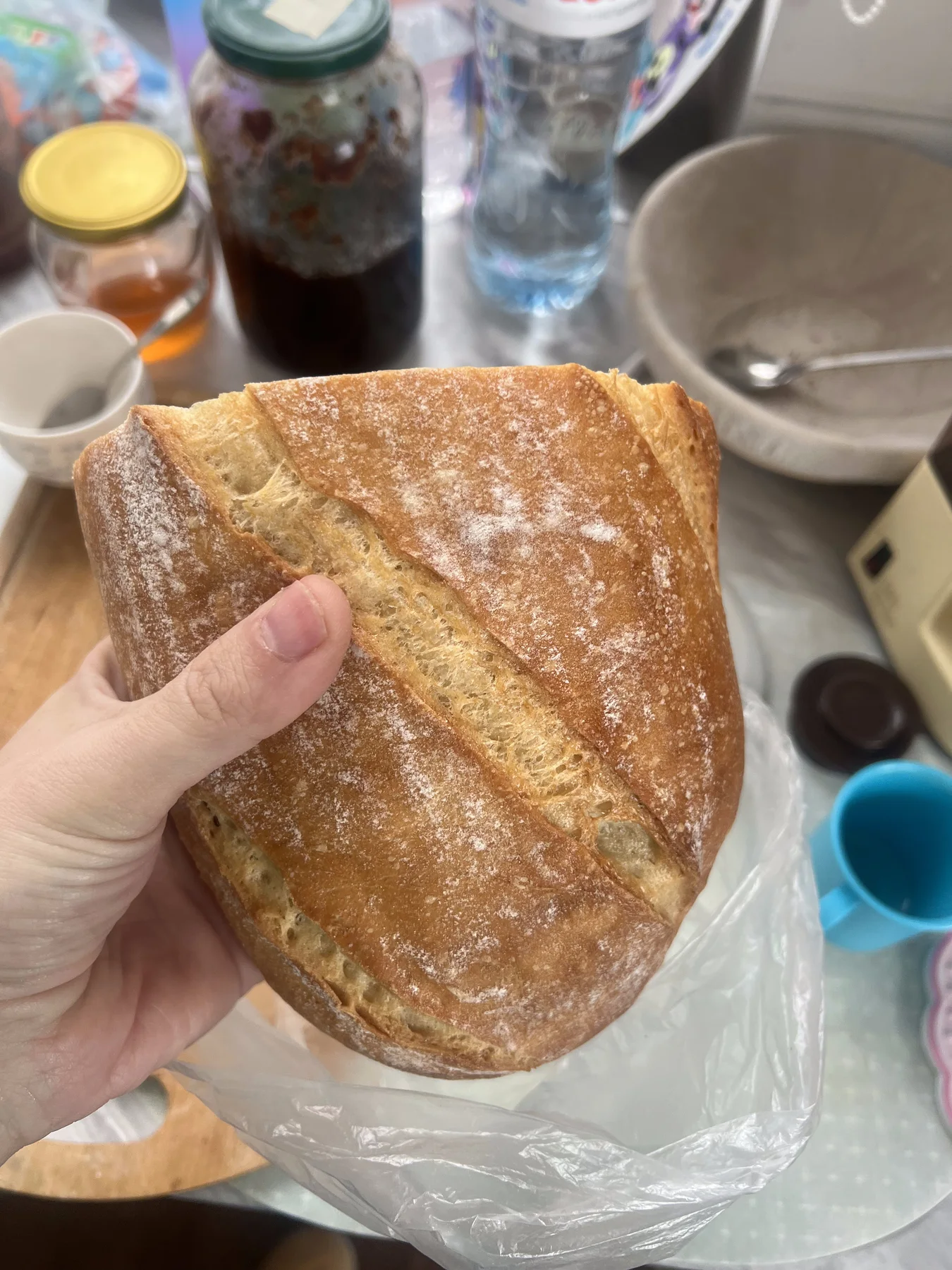
Pillowy-soft, fine crumb with a springy, moist mouthfeel — the tangzhong keeps the inside tender well into the next day. Flavor is gently sweet with a clean dairy note from the milk and butter; no sourness. The thin, golden crust stays crisp when fresh and softens slightly by day two, while the crumb remains sliceable without tearing or gumming. Overall character: mild, comforting, lightly enriched — closer to a soft everyday loaf than a lean hearth bread, yet baked as a batard on stone it carries a proper open crust.
As described by: King Arthur Baking: Tangzhong, the secret to softer bread , Dessert First: Hokkaido Milk Bread — The Tangzhong Method
Baking worksheet
Good to know
Why is the bake time shorter than 38–40 minutes?
On 23 Apr the loaf reached 95.2 °C at 31 min 20 sec. One more clean bake should confirm whether the note should be changed.
Why are the center pores smaller than near the crust?
That gradient can happen in hearth bread: outer layers heat earlier, while the center expands less. In the photo it does not look like a defect.
The loaf deflated a bit after scoring — is that normal?
It signals the cold retard was at the upper end of the window (10+ hours at 70.8% hydration with tangzhong). The dough is at peak; the lame breaks surface tension and gas escapes. The oven spring recovers it, and the finished loaf is fine. If it repeats — shorten retard to 9 hours or try a sharper lame.
Tangzhong white bread is a soft, enriched hearth loaf: strong flour, milk, sugar, and butter, with part of the flour scalded into a starch paste before mixing. That paste — the tangzhong — is what sets this bread apart from a plain white loaf. It binds water inside the crumb so the bread bakes softer, slices cleanly, and stays fresh longer, while the milk, sugar, and butter give it a gentle dairy-sweet flavor and a thin golden crust.
How it’s baked around the world and why
Tangzhong is an Asian technique that traveled west. The method of scalding flour with hot liquid before mixing is old in East Asia, and two named versions dominate.
In Japan it is yudane: equal weights of flour and just-boiled water are mixed and rested overnight, gelatinizing the starch slowly and fully. Yudane is the classic route to shokupan, the tall, pillowy milk-bread loaf with a fine, cottony crumb that tears in soft sheets. In China and across the Chinese diaspora the same idea is tangzhong (湯種, “soup seed” or “hot starter”): a smaller share of flour — usually 5–10% — is cooked with about five parts water on the stove to roughly 65 °C, the temperature where wheat starch gelatinizes, then cooled and added to the dough. It was popularized for home bakers across Asia by Yvonne Chen’s 2007 book and is now the standard trick behind soft Hong Kong-style buns, milk bread, and cream rolls.
The reason the technique spread is the same everywhere: a gelatinized starch paste holds several times its weight in water and releases it slowly, so the finished bread is softer, more moist, and stales more gradually — exactly the qualities prized in Asian soft-bread culture, where bread is eaten plain, sweet, or filled rather than alongside a savory meal. Western bakeries adopted tangzhong for the same payoff in sandwich loaves, burger buns, and dinner rolls, where shelf-softness matters. This recipe keeps the East Asian water-roux core but bakes it as a European-style hearth batard on a stone with steam, rather than in a closed pan, so it gains an open crust while keeping the tangzhong softness inside.
Full course map: Bread curriculum.
Theory
Tangzhong means cooking part of the flour and water into a thick paste, around 65 °C. Starch binds water, so the bread can feel softer and stay moist longer. Milk, sugar, and butter also change flavor, fermentation, browning, and crumb structure. Judge this bread by softness, thin crust, slicing quality, next-day freshness, and a gentle milk-sweet profile.
What Tangzhong Changes
Tangzhong is not an aroma preferment. It is a water-management tool. A small share of flour is heated with water until starch granules swell and thicken the mixture. That paste carries water into the final dough in a less mobile form, so the baked crumb can feel softer and dry out more slowly.
The important practical consequence: do not raise total hydration just because the dough feels manageable. Tangzhong already changes how water behaves. If the loaf is wet or gummy, the next check is cooling, proofing, and bake temperature before adding more water.
How the enrichments change the dough
Milk, sugar, and butter change the control logic of a plain wheat dough.
| Ingredient | Main effect | Risk |
|---|---|---|
| Milk | Adds lactose, proteins, and a softer dairy note | Faster browning and a heavier crumb if proof is weak |
| Sugar | Feeds sweetness and browning more than structure | Crust can darken before the centre is ready |
| Butter | Tenderizes and shortens the crumb | Added too early, it can slow gluten development |
| Tangzhong | Keeps water in the crumb matrix | If underbaked, the crumb can read as damp rather than soft |
Judge this bread by softness, even slicing, thin crust, and next-day freshness, not by the open, irregular crumb expected from a lean hearth loaf.
Shaping the Batard (in detail)
Shaping soft tangzhong dough is its own technique. The dough is around 60% hydration plus butter — firm but sticky; enriched, so butter “flows” under warm hands. The goal of shaping is a tight surface without forcing out gas and without tearing the gluten film.
1. Prep the bench (1 min)
Lightly dust the work surface with flour — literally a tablespoon, a thin film. Excess flour leaves dense “unrolled” streaks inside the crumb. Have ready: bench scraper, banneton or pan, contact film or an inverted bowl for the bench rest.
2. Transfer to the bench (1–2 min)
After bulk, the dough is stuck to the container walls. Run the scraper around the perimeter to release. Invert the container onto the bench — the dough should slide down. If it clings, help with the scraper and fingers; do not yank: a jerk tears the gas pockets and you’ll have to re-shape.
After the transfer, the dough sits as one piece with a slight slump and a matte surface. That is normal.
3. Preshape (2–3 min)
Goal — round the dough and order the structure without forcing gas out.
- With the scraper and hands, fold the edges toward the center from four sides, like a dumpling
- Flip seam-side down
- Tighten the surface: with both palms, push the dough away on the bench in small arcs, rotating it a quarter turn between motions; repeat 2–3 times
- Do not press hard — we are ordering the form, not degassing
Result: a round/oval “package” with a tight matte top.
4. Bench rest 10 minutes (not 5)
Cover the dough with contact film or an inverted bowl. A towel on top is not ideal — it abrades the surface and dries it. 10 minutes is the justified minimum for enriched dough:
- 5 minutes is too short: gluten is still under tension after preshape; final shaping will tear the film
- 10 minutes is right: gluten relaxes, the dough stretches without tearing
- 20+ minutes is too long: the dough loses strength and the final batard won’t hold form
If the kitchen is hotter than 25 °C, cut the bench rest to 7 minutes (butter starts to melt, dough overheats).
5. Final shaping of the batard (5 min)
- Flip the dough seam-side up on the lightly floured bench
- Stretch into a rectangle ≈25×20 cm (long side along the future batard axis, short side toward you)
- Fold the top third to the center; seal the seam line with fingers
- Fold the bottom third over; seal
- Turn 90° (long side now toward you)
- Roll into a log from the near edge to the far edge, pressing each turn with the heel of the palm (not the fingers — they tear the dough)
- Seal the seam: press it shut along the full length with the fingers
- Flip the batard seam-side down; roll under the palms across the bench 2–3 times for length and final tension
6. Into the banneton or pan (1 min)
- Into a banneton: dust lightly with flour (thin film); transfer the dough seam-side up (during baking it flips seam-down, the banneton pattern shows on top)
- Into a pan (Pullman or 9×5): transfer seam-side down
- Cover with a dome or large container without contact with the dough
- To the fridge for retard
Checkpoints
| What to check | Norm | If off |
|---|---|---|
| Surface after final shape | Tight, smooth, doesn’t stick to hands | Lightly dust with flour, retighten |
| Seam | Fully sealed, doesn’t open | Press shut again with the heel of the palm |
| Dough temperature | Up to 26 °C | If higher — 10 min in the fridge before shaping |
| Batard shape | Symmetric, no skew | Roll under the palms again, even the ends |
Before Loading (Pre-Bake)
Cold retard finishes the final proof — the loaf is ready for the oven. The main question: take it out earlier to “warm up” to room temperature, or straight from the fridge onto the stone?
Short answer: take out 15 minutes before, no longer
Cold dough is easier to handle and gives better oven spring. But 10–15 minutes on the bench are useful — to let surface condensation evaporate (the loaf “sweats” in the first minutes; a wet surface won’t take a clean score and won’t respond well to steam).
Why NOT a long warm-up (30–60 min)
- Enriched dough (milk + 20 g sugar + 20 g butter) softens at room temperature; the loaf loses height and batard symmetry
- Cold retard has already completed proofing: an extra 30–60 minutes on the bench pushes it past peak (finger poke stops springing back → dense crumb and side cracks)
- Cold dough = cleaner scores: the lame doesn’t stick, the score opens wide and even
- Cold surface holds off crust formation longer — more oven-spring window
Why 10–15 minutes are still useful
- Surface condensation evaporates — cleaner score, steam does its job
- Stones and oven reach target temperature right at the end of these 15 minutes — synchronization
- Surface is slightly softer for a careful transfer to the peel
Practical protocol
| Time before loading | Action |
|---|---|
| −70 min | Turn on the oven (210 °C, top-bottom, with both stones): the stones need another 45 minutes after it reaches temperature |
| −15 min | Take the loaf out, remove the cover, let the surface dry |
| −5 min | Score (long longitudinal for a batard, or 3–4 angled at 30°), prepare steam |
| 0 min | Load onto the stone, steam immediately |
If the kitchen is warmer than 25 °C
Shorten the warm-up to 5–7 minutes (butter melts fast). You can score straight from the fridge and gently pat any moisture off with a paper towel.
If something is off
- Damp or gummy crumb → underbaked, not over-hydrated; bake to 94–95 °C internal and do not add water to compensate for tangzhong.
- Tight lower crumb, uneven spring, tearing → underproofed; let the cold retard finish and confirm the poke test returns slowly.
- Weak top, poor oven spring, fragile slice → overproofed; the soft enriched dough widens the window, so pair the poke test with volume and dough strength, and shorten the retard toward 9 h.
- Crust too dark before the centre is done → milk and sugar brown fast; drop to the 190 °C phase sooner and judge doneness by probe, not crust color.
- Loaf deflates after scoring → the dough is at peak from a long retard; use a sharper lame and try 9 h cold retard next bake.
- Hard or thick crust, dries out fast → too long a bake or no steam; keep built-in steam until minute 8 and stop by probe.
Freshness Check
The real test is not the first warm slice. Check again the next day.
| Time | What to check |
|---|---|
| 1–2 h after baking | Softness, moisture, crust thickness, clean dairy-sweet aroma, no wet gumminess |
| Next day | Whether the crumb stayed soft, slices cleanly, and avoids rubbery or dry texture |
If the bread is only good warm, the method did not do its job — softness and next-day freshness are the whole point of tangzhong.
Theory Sources
- King Arthur Baking: Tangzhong technique — practical explanation of water roux and soft bread.
- The Staling and Texture of Bread Made Using the Yudane Dough Method — study on scalded flour, water retention, softness, and staling.
- Arabinoxylans as Functional Food Ingredients: A Review — background on water binding in cereal systems.
- Chemistry of bread aroma: A review — review of fermentation, baking, crust, and bread aroma.
Home Adaptation
This keeps the professional soft-bread idea in a home format. Tangzhong is cooked in a small pan to a thick paste, ideally near 65 °C, then cooled before mixing. The loaf uses a normal oven with a baking stone, built-in steam, and a probe thermometer.
Sugar, milk, butter, and tangzhong change browning, softness, slicing quality, and staling speed, so the required home check is next-day freshness — not the look of the warm loaf.
Ingredients
Change any amount — the rest rescale by the bread’s formula.
| Component | Grams | Baker's % |
|---|---|---|
| Strong white bread flour | g | 100% |
| Water | g | 60.05% |
| Milk | g | 12.24% |
| Fresh yeast | g | 1.15% |
| Sugar | g | 4.62% |
| Butter adjusted for the milk | g | 4.62% |
| Salt | g | 2.08% |
| Water — milk adjustment | g |
Preferments, scalds, and old dough are shown as prepared components; their composition is listed in the row details and worksheet.
Ingredient details
Strong white bread flour
- Type
- MukaMuka 13.5% protein or a similar strong flour
- Split
- 33 g in tangzhong, 400 g in the main dough
- Brand the author uses
- MukaMuka 13.5% protein (mukamuka.ru)
- Alternatives
- Aleyna Vivapol 12-13%, King Arthur Bread Flour 12.7%
Water
- Split
- 167 g in tangzhong, 93 g in the main dough
- Brand the author uses
- Tap water through Barrier Iron x2 filter
- Alternatives
- any filtered or bottled drinking water
Milk
- Composition (for water math)
- Whole milk 3.2% contains ~88% water (USDA FoodData Central, ID 171265). For 53 g of milk, ~46.6 g water. Real dough hydration = 167 g in tangzhong + 93 g free + 46.6 g from milk = 306.6 g water per 433 g flour (~70.8%).
- Brand the author uses
- Lebedyan 3.2%
- Alternatives
- any 3.2% milk (Prostokvashino, Domik v Derevne)
Fresh yeast
- Brand the author uses
- Lux (Voronezh) fresh or Ayrek (homemade)
- Alternatives
- any fresh yeast in 100 g pack
Sugar
- Brand the author uses
- White sugar, no specific brand
- Alternatives
- any white sugar; for brown — Mistral demerara
Butter
- Brand the author uses
- Vologodskoye 82.5% (VkusVill)
- Alternatives
- any 82.5% butter (Anchor, President, Prostokvashino)
Salt
- Brand the author uses
- Pink Himalayan salt
- Alternatives
- sea or table salt (avoid iodized)
Conditions and equipment
Conditions
- Evening kitchen
- 22.7–23.2 °C during bulk, 34–36% humidity
- Morning kitchen
- 22.1–24.2 °C during preheat and bake
- Fridge
- 9 h in the 23 Apr 2026 control bake
- Internal temperature
- 92.4 °C at 28 min; 95.2 °C at 31:20
Equipment
- Oven
- Haier HOQ-F6QS, top-bottom heat
- Stone
- two Estet baking stones (2 cm thick): 40×30 cm on the 2nd level from the top (top heat) and 30×25 cm on the 2nd level from the bottom; load the piece onto the lower stone (30×25) so steam reaches the dough from below. Preheat both to 210 °C, turning the oven on 70 minutes before loading: the stones need another 45 minutes after it reaches temperature. Without a stone (steel, sheet pan) heat transfer differs and the regime needs adjusting
- Steam
- built-in oven steam until minute 8
- Mixer
- Kenwood KVC85.004SI with dough hook; use speed 2 only briefly if butter incorporates slowly and dough stays cool
- Format
- hearth batard on stones
Nutrition: soft tangzhong white bread
Bread nutrition facts
Per 100 g of bread
256 kcal
protein 7.7 g · fat 3.6 g · carbs 47.3 g
Per slice (50 g)
128 kcal
protein 3.9 g · fat 1.8 g · carbs 23.7 g
Automatic calculation from USDA + Skurikhin database for the baked loaf after evaporation. Numbers are approximate: 1) the database covers ingredients, not finished dough; 2) bake water loss is assumed at 10% — actual loss depends on crust, time, and pan. Add 5–10% in calorie trackers if needed.
Tangzhong improves water retention and softness, but this version also contains milk, sugar, and butter. Treat it as a soft enriched bread, not as the main daily grain staple.
- Digestion
- The moist crumb is easy to eat quickly. White flour and sugar make the carbohydrate load more dessert-like, while butter and milk raise energy density.
- Helpful or harmful
- It can fit into a balanced diet in a modest portion. The issue is not tangzhong itself; it is large sweet portions replacing whole, fibre-rich foods.
- Amount
- A practical serving is 1 slice, about 40–70 g. With butter, jam, honey, or a sweet drink, count it as dessert-like food.
- Best pairings
- Pair with cottage cheese, eggs, cheese, plain yogurt, or berries without extra sugar. For a meal, add protein and vegetables rather than another sweet layer.
How to eat
- Judge the lesson by softness and next-day freshness, but do not confuse technical success with daily nutrition value.
- For learning, one thin slice on bake day and one slice the next day are enough to compare storage.
Limits
- Contains gluten, dairy, and added sugar.
- Adjust portions for diabetes, milk intolerance, or diets limiting saturated fat.
Instructions
-
Cook tangzhong
Cook 33 g flour and 167 g water to a thick paste around 65 °C, then cool fully.
-
Mix dough
Mix tangzhong, 400 g flour, 93 g water, milk with yeast, and sugar; add salt, then softened butter.
-
Bulk ferment
Ferment 1.5–2 h at 22.7–23.2 °C with no mandatory folds; observe dough state and aim for about 1.5x rise.
-
Shape and chill
Preshape, rest 10–15 min, shape into a batard, then refrigerate 9–12 h; 70 minutes before loading, while the loaf is still in the fridge, turn on the oven with both stones at 210 °C.
-
Bake
Bake on stones at 210 °C with steam, then 190 °C dry, to 94–95 °C internal.
-
Cool
Cool at least 1 h on a rack, then slice and evaluate the crumb.
Version history
Show version history
- v3.6September 24, 2026
- Problem
- The card turned the oven with two stones on 1 hour before loading, while the author measured on this very bread on 23 Apr: the oven reached 215 °C in 25 minutes and the stones then heated for another 45 — 70 in total.
- Change
- At the author’s decision the oven is turned on no earlier than 08:00. Evening shaping ends by 22:00 (tangzhong at 08:55 in the morning mode and at 17:55 in the evening mode, mix at 19:55), the cold retard lasts until the oven is turned on at 08:00, the 70-minute preheat is a separate step, pre-bake at 08:55, loading at 09:10. The loaf stays in the fridge 10 h 55 min instead of 9 h 40 min (9 h 55 min before in the morning mode, which now gets the pre-bake step, as in the Russian card): with the oven on no earlier than 08:00 and shaping no later than 22:00 it cannot be shorter, so the 9-hour trial planned for the next bake is impossible at the card’s start time. The “70 minutes before loading” timing is stated in the equipment, the bake step, the short instructions and the protocol table; mode descriptions, prepTime and totalTime match the schedule.
- Result
- —
- v3.5May 27, 2026
- Problem
- The recipe worked on a single successful bake on 23 Apr 2026 (status: theoretical) but had not been re-validated — especially the new evening mode with counter-cooled tangzhong and the pre-bake step.
- Change
- Status promoted to reproduced after a successful repeat bake on 27 May 2026 (evening start 17:00, cold retard 10.5 h, 30-minute bake to 96.8 °C internal). Added FAQ about deflation after scoring and a note that 10.5 h cold retard is the upper end of the window.
- Result
- Evening mode validated: tangzhong cools on the counter for 2 h under cling film without issue; the pre-bake step (15 min) gives a clean score without losing oven spring. Kitchen at 23.4 °C during bulk, 22 °C in the morning — stable.
- Conclusion
- Next bake: try cold retard at 9 h (the lower bound of the 9–12 h window) — hypothesis that the loaf will not reach peak and the score will not bleed gas.
- v3.4May 24, 2026
- Problem
- The mix step did not show an explicit duration.
- Change
- Added a 15-minute mix timer and aligned the wording with the Kenwood process.
- Result
- The S2-C1 worksheet now shows a clear 15-minute mixing window.
- Conclusion
- Mixing now has an explicit duration, while dough readiness is still confirmed by texture, temperature, and development.
- v3.3May 8, 2026
- Problem
- The English lesson theory was shorter than the current course standard.
- Change
- Expanded the mechanism, diagnostics, and theory sources for tangzhong, enriched dough, proofing, baking, and freshness.
- Result
- S2-C1 now explains what tangzhong changes and how to evaluate it without applying lean-bread criteria.
- Conclusion
- Judge the lesson by softness, slicing quality, crust, and next-day freshness.
- v3.2April 30, 2026
- Problem
- The modern-method review found that the lesson needed a clear home adaptation and control questions.
- Change
- Added home controls for tangzhong texture, dough temperature, proofing, probe baking, and next-day freshness.
- Result
- S2-C1 now teaches soft-bread method and shelf-life, not only a working formula.
- Conclusion
- Keep the formula and verify softness and storage before changing ingredients.
- v3.1April 30, 2026
- Problem
- The English page showed tangzhong bread as a standalone recipe, not as the first S2 soft-wheat lesson.
- Change
- Added S2-C1 course framing, tangzhong theory, sensory checks, and the course-map link.
- Result
- The page now separates soft bread goals from the lean/artisan S1 track.
- Conclusion
- The next test should confirm both bake time and softness/freshness.
- v3.0April 23, 2026
- Change
- Keep the formula; verify the shorter bake window with another clean point.
- Result
- Good crust color, soft even crumb, tall loaf.