100% rye-flour pan loaf (Vollkornbrot)
Whole-grain rye · pan loaf · sourdough
100% rye-flour pan loaf Vollkornbrot-style on sourdough opara, without wheat flour, scald, or malt.
Live timing needs JavaScript enabled.
Calculated for the current time; the worksheet lets you set any start.
Recipe
Current recipe
For baking now: the final working formula, ingredients, steps, and baking worksheet.
Taste & texture
Dense, fine-pored crumb — not open, but moist and cohesive after the mandatory 12-24 h rest. The crust is firm and thin with a matte surface. Flavor leads with earthy whole-rye grain notes and a clean, pronounced sourness from the large sourdough opara; no sweetness without malt or scald. The aftertaste is long and grainy with a slight mineral edge. No seeds or enrichments, so the rye character is unmasked: bakers describe 100% rye loaves as fruity-earthy and almost wine-like in complexity. Keeps well for 5-7 days wrapped, and flavor smooths and deepens by day two.
As described by: Zingerman's Bakehouse — Vollkornbrot , Yummy Sourdough — Sourdough German Vollkornbrot Rye Bread Recipe
Baking worksheet
Good to know
Why is 100% rye flour the densest crumb in the course?
100% rye flour has no gluten network like the one wheat dough uses to hold large pores. Structure is held by starch, pentosans, and acidity; the result is a dense fine-pored crumb, and that is normal for Vollkornbrot, not a defect.
Why are 12 hours of rest mandatory?
Right out of the oven the rye crumb is still unstable: the hot starch gel and bound water must redistribute. A slice at 1–2 hours will show stickiness that disappears in 12 hours.
Can it be baked as a hearth loaf, without a pan?
Pure 100% rye-flour dough holds a hearth shape poorly without rye sifted flour or a grain base. For the control lesson it is simpler to use a pan and not mix variables.
Why such a large opara (40% prefermented flour)?
In 100% rye-flour bread the opara acidity makes the crumb edible: without it rye-flour enzymes destroy the starch and the bread turns gummy. 40% is the lower working bound for home Vollkornbrot.
This is a pure 100% rye-flour bread: no wheat flour, no scald, no malt, and no spices. The whole point is to see how a sourdough opara and a mandatory rest turn the densest rye formula from a brick into an edible loaf with clean acidity — where the line between dense and gummy lies, and how to tell an opara error from a hydration or bake error.
How It’s Baked Around the World, and Why
A 100% rye loaf is the everyday bread of the northern grain belt — Germany, the Baltics, Poland, Scandinavia, and Russia — wherever the climate favored rye over wheat. The shared logic is the same everywhere: rye flour cannot be raised by yeast and gluten the way wheat is, so the structure is built on sour fermentation and a long, gentle bake in a tin.
Germany’s Vollkornbrot is the textbook version — coarse wholemeal rye, often with cracked grain or rye chops soaked in, baked low and slow for an hour or more in a Pullman-style tin, then rested for a day. Northern logic again: a dense, moist, keeping bread that slices thin and lasts a week. The Baltic and Polish ruginė / razowy breads run the same playbook, sometimes lifting the share of sifted rye flour for a lighter crumb. Russian and Ukrainian black breads add a scald (zavarka) and red rye malt for sweetness and color, but the backbone — a big mature sour, a tin, a full bake — is identical.
Why a tin and not a hearth? Pure rye dough has no gluten net to hold a free-standing shape; without sifted flour or a grain base it would spread. The tin contains it until acidity and gelatinized starch set the crumb. Why so much sour? Because rye amylase stays active deep into the bake and will liquefy starch unless a low pH stops it — the reason every traditional 100% rye recipe leans on a large, well-soured preferment. And why the day-long rest? The hot rye crumb is a starch gel still holding free water; cut it early anywhere and it smears. The rest is not a serving suggestion — it is the last step of the bake.
Theory of 100% Rye-Flour Bread
In wheat bread the main scaffold is the gluten network. In 60/40 half of that work is done by wheat flour. In 100% rye flour there is almost no gluten: structure is held by starch, pentosans, and acidity.
| Mechanism | Role in 100% rye flour | What to check |
|---|---|---|
| Sourdough opara | Main source of gas, acidity, and enzyme control | Dome, bubbles, sour rye smell without vinegar |
| Acidity | Stops rye-flour amylase from destroying starch | Opara smell, crumb density after rest |
| Pentosans | Bind water and hold the dough, imitating a gel | Thick paste, not a flowing dough after mixing |
| Starch | After baking forms the main crumb scaffold | 98–99 °C internal, mandatory rest |
| Pan | Holds the dough until acidity and starch take over the work | Starting height, 1.5–1.8x rise |
If the opara is weak, the crumb will be sticky and gummy even with an ideal bake. If the opara is working but the bread is cut after an hour, the crumb will look sticky by mistake.
Why the Opara Is So Large
This loaf uses 40% prefermented flour — the lower working bound for a home 100% rye-flour bread. A smaller share will not give enough acidity, and rye-flour amylase will destroy the starch during baking. On the slice this looks like a gummy band at the bottom or a transparent moist zone.
| Share of prefermented flour | Expected result |
|---|---|
| 20–30% | Often not enough for 100% rye flour; risk of gumminess |
| 40% | Working baseline here |
| 50%+ | Stronger acidity, denser crumb, profile closer to classic Vollkornbrot |
Once the bread reliably works, the opara share can shift up or down — but change only one variable at a time per bake.
Why Three Refreshments from the Refrigerator
This bread does not use the culture straight from the refrigerator. After long storage, wild yeast in the starter is slowed, and the balance is shifted toward lactic acid bacteria. Three refreshments at 5+10+10 → 5+15+15 → 5+20+20 are needed for two things:
- Boost yeast activity for normal opara rise.
- Clear the flavor profile from the sharp vinegar accumulated in the refrigerator.
After the third refreshment, out of the small active jar, 15–20 g goes to the refrigerator as the new mother-culture reserve, 20 g goes into the opara as active starter, and the small remainder covers jar and weighing losses.
How a 100% Rye-Flour Crumb Holds Together
In wheat dough the key question is “did the windowpane develop?”. In 100% rye-flour dough this question does not exist at all. The main question is: “is there enough acid, gas, and bound water?”.
A thick paste after mixing is normal. Dough stickiness on the hands is normal. The dough should not “pull away from the bowl walls”; it should not “gather into a ball”. Trying to knead it like wheat — Kenwood with the hook for 10 minutes — will destroy the fragile pentosan gel structure, and the crumb will turn out denser, not lighter.
Rest as Part of the Recipe
12 hours after baking is not “advice” but a working part of the recipe.
| Slice time | What you see |
|---|---|
| 1–2 hours | Hot sticky crumb, knife smears, falsely looks like gumminess |
| 6–8 hours | Partially stabilized, but moisture is still redistributing |
| 12 hours | Minimum window for honest assessment |
| 24 hours | The best window for this loaf |
| 48 hours | Flavor settled, acidity smoothed |
If the crumb seems sticky at 12 hours on the first run, check at 24 hours. Often it is not gumminess but a lack of rest.
Full Course Map
Bread curriculum — where this rye loaf sits in the overall track.
Theory Sources
- Vollkornbrot: classic German 100% rye-flour pan loaf — practical German frame for 100% rye-flour bread with a large opara.
- Sourdough Bread Quality: Facts and Factors — review of the role of sourdough and acidity in bread quality.
- Arabinoxylans as Functional Food Ingredients: A Review — review of water binding by pentosans in rye-flour crumb.
If Something Goes Wrong
- Gummy crumb under the knife at 12 h — pentosans have not finished resting; wait a full 24 h before slicing, 36 h next time.
- Gummy band at the bottom, or a transparent moist zone — rye amylase outran the acid; raise the opara share toward 50% or give the opara longer, and make sure it smells pronouncedly sour.
- Dome fell in the oven — overripe opara or overproof; hold the opara to 1.8–2.5x only and proof the loaf to 1.5–1.8x.
- Sharp vinegar smell — opara over-soured (12+ h at 27+ °C); shorten to 10 h or refrigerate it after 6 h.
- Crust separates from the crumb — fermentation too weak; ripen the opara overnight at 24–27 °C rather than cold.
- Dough tears on the bench — normal for 100% rye flour, which gives no windowpane; work with wet hands and do not add flour.
Ingredients
Change any amount — the rest rescale by the bread’s formula.
| Component | Grams | Baker's % |
|---|---|---|
| Whole rye flour | g | 100% |
| Water | g | 80% |
| Salt | g | 2% |
| Active rye starter, 100% hydration | g | 4% |
Ingredient details
Whole rye flour
- Split
- 200 g into the sourdough opara and 300 g into the final dough
- Brand the author uses
- record the brand and milling before baking
- Production date
- record before mixing
Water
- Split
- 200 g into the sourdough opara and 200 g into the final dough
- Temperature
- room temperature; record actual dough temperature after mixing
Salt
- Important
- if the salt is coarse, dissolve it in water or grind finer
Active rye starter, 100% hydration
- Role
- active starter for the sourdough opara from the final refreshment
- Accounting
- included in opara and dough mass; formula flour/water stay 500/400 g excluding that active starter, matching the working-sheet convention
Conditions and equipment
Conditions
- Focus
- 100% rye flour, sourdough opara, dense crumb, mandatory rest
- Doneness temperature
- 98–99 °C internal; probe thermometer required
- Done right when
- the 100% rye-flour crumb stabilizes for 12+ hours and the knife does not stick
Equipment
- Pan
- rectangular pan loaf form (Emile Henry Petit Moule Cake or similar volume)
- Mix
- Kenwood KVC85.004SI, K-beater on Min; do not use the hook
- Oven
- top-bottom heat, hand steam or steam generator on the start phase
- Control
- probe thermometer, scale, starting-height mark for the dough
Nutrition: how to eat this bread
Bread nutrition facts
Per 100 g of bread
185 kcal
protein 5.3 g · fat 1.1 g · carbs 37.7 g
Per slice (50 g)
93 kcal
protein 2.7 g · fat 0.6 g · carbs 18.9 g
Automatic calculation from USDA + Skurikhin database for the baked loaf after evaporation. Numbers are approximate: 1) the database covers ingredients, not finished dough; 2) bake water loss is assumed at 10% — actual loss depends on crust, time, and pan. Add 5–10% in calorie trackers if needed.
Bread is a source of starch and energy. Its nutrition depends on flour, fermentation, salt, enrichment, serving size, and the rest of the plate.
- Digestion
- More whole grain, fibre, and fermentation usually mean longer satiety. White flour eaten alone is generally digested faster.
- Helpful or harmful
- Bread is not poison or medicine by itself. Overall diet matters; current guidance prioritizes whole grains, vegetables, fruits, and pulses.
- Amount
- For most learning tastings, 1–2 slices, about 30–80 g, is enough depending on loaf density.
- Best pairings
- Pair with protein, vegetables, and moderate fat; avoid making it a large standalone portion with sweet drinks or sweet spreads.
How to eat
- Taste the bread plain for learning, then eat it as part of a balanced plate.
- Slice dense rye thinner; with soft white bread, make sure softness does not automatically increase the serving.
Limits
- Wheat and rye breads contain gluten.
- For medical conditions, adjust bread type and serving size with a clinician or dietitian.
Instructions
-
Prepare the starter
Take the rye-flour starter out of the refrigerator. Do 3 refreshments: 5+10+10 → 5+15+15 → 5+20+20; the final refreshment is small and should be used at peak.
-
Set aside reserve and build the opara
Before building the opara, set aside 15–20 g of active starter into a clean jar and put it in the refrigerator. Mix 200 g rye flour, 200 g water, and 20 g active starter. Hold 10–14 hours at 24–27 °C to a dome and a milky-sour smell.
-
Mix
Put all the opara, 200 g water, 10 g salt, and 300 g rye flour into the Kenwood bowl. Mix with K-beater on Min 1–2 minutes to homogeneity; stickiness is normal.
-
Transfer to the pan
Grease the pan, transfer the dough, smooth with a wet spoon or wet fingers; mark the starting height and dough mass.
-
Proof
Proof at 24–28 °C to 1.5–1.8x rise; cues — top slightly domes, fine cracks appear.
-
Bake
Timers: 250 °C 10 minutes with steam, 200 °C 30 minutes, 170 °C 30 minutes to the first probe check; if the inside is below 98 °C, add 5-minute top-ups at 170 °C.
-
Rest
Remove from the pan, cool on a rack uncovered, wrap in cotton/linen. Do not slice earlier than 12 hours, ideally 24 hours. The slice is needed for the crumb conclusion.
Version history
Show version history
- v1.2July 2, 2026
- Problem
- The lesson stayed theoretical: a levain build carrying 40% of the flour, and the mandatory rest before slicing, had never been tested by an actual bake.
- Change
- First bake strictly to the plan: MukaMuka whole-grain rye flour, 400 g water (80%) with no correction, levain build and baking profile as written, probe to 98 °C, about 24 hours of rest before slicing.
- Result
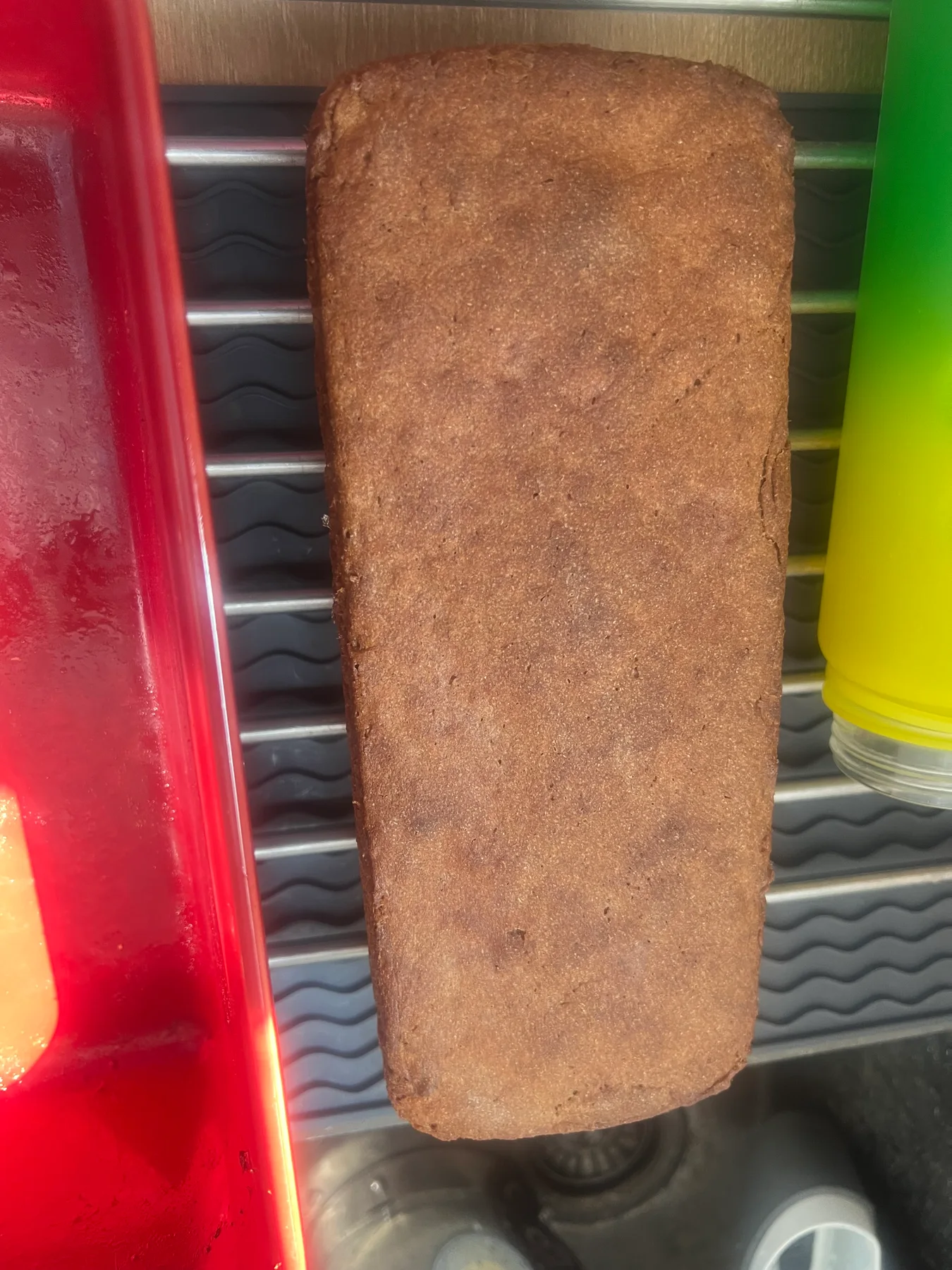
- Success. The loaf holds its shape — an even brick with a smooth crust and a single lengthwise crack on top. The crumb is even, fine-pored, fully baked, not sticky, with no gummy band at the bottom; the taste is good. The lesson's hypothesis is confirmed: 40% prefermented flour plus about 24 hours of rest give a dense but not gummy, genuinely edible 100% rye crumb.
- Conclusion
- Formula and plan work as they stand — no changes to the recipe or the timing are needed. The 40% levain share is fixed as the norm: lowering it is unnecessary (below 40% risks a gummy crumb), raising it to 50%+ only for a sourer classic profile.
Development history (2)
Intermediate theoretical notes before the first bake.
- v1.1July 1, 2026in development
- Problem
- The formula and working sheet used different masses: the sheet built the opara from 200 g flour + 200 g water + 20 g active starter, but recipeMath counted the opara as 400 g and the top ingredient list did not show that active starter.
- Change
- Added 20 g active rye starter at 100% hydration to visible ingredients and recipeMath; corrected sourdough opara mass to 420 g. Base baker's percentages for flour/water remain on 500/400 g, and the cheatsheet now shows the effective active-starter-inclusive formula: 510 g flour, 410 g water, 80.4% hydration.
- Conclusion
- The working sheet now matches the actual mix: about 420 g opara and about 930 g dough.
- v1.0May 25, 2026in development
- Problem
- In the R1-C rye-flour track, after R1-C1 (60/40) and R1-C2 (80% rye flour), a transition is needed to a pure 100% rye-flour pan loaf without scald or malt.
- Change
- Created R1-C3: 500 g whole rye flour, 400 g water (80%), 10 g salt, sourdough opara with 40% prefermented flour; multi-day sheet with 3 refreshments and a mandatory 12-hour crumb rest.
- Conclusion
- The lesson checks whether a sourdough opara at 40% and a mandatory rest can give a stable 100% rye-flour crumb in a pan loaf without help from wheat flour or scald.