Lean wheat baseline (direct dough)
Wheat · hearth · lean
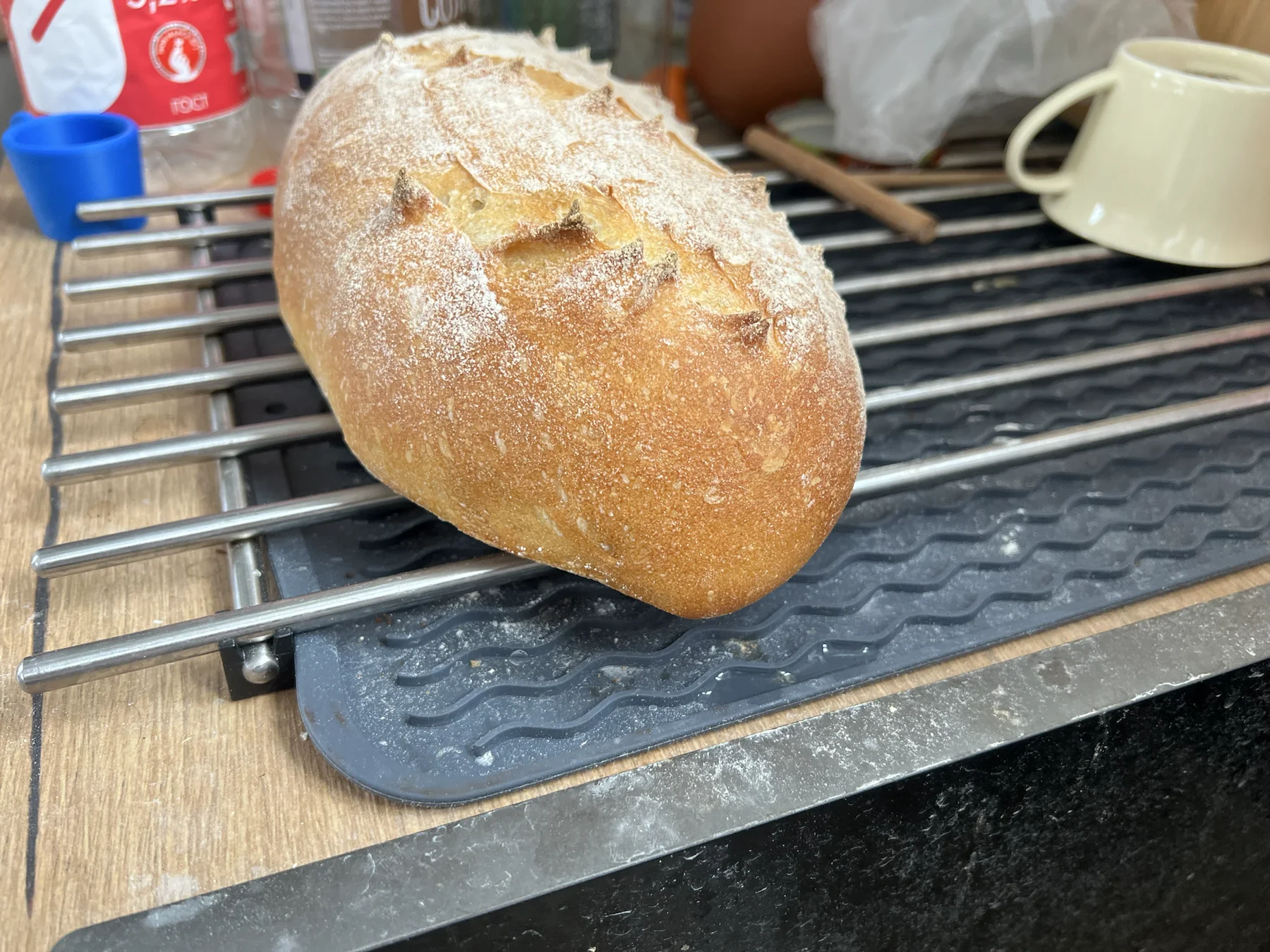
Lean wheat bread made from flour, water, salt, and fresh yeast — a clean baseline loaf without tangzhong, milk, butter, sugar, or sourdough.
Live timing needs JavaScript enabled.
Calculated for the current time; the worksheet lets you set any start.
Recipe
Current recipe
For baking now: the final working formula, ingredients, steps, and baking worksheet.
Taste & texture
Thin, crisp crust that crackles on the first bite and softens to a paper-thin shell by the next day. The crumb is moderately open with irregular pores — chewy but not tough, with a clean, straightforward wheat flavour and no tang or sweetness. Aroma is mild: a light baked-grain note, nothing sharp. This is the honest baseline of a lean direct dough — flavour comes almost entirely from the flour and fermentation, without any enrichment or preferment to deepen it. Best eaten the same day while the crust holds.
Baking worksheet
Good to know
Why is the recipe not improved with additions after the 2/10 score?
S1-C1 is required as a clean learning formula. Flavor through fermentation is studied in S1-C2, while softness, milk, sugar, butter, and tangzhong are moved into a separate soft wheat track S2.
Why not just wait exactly until the scheduled time?
Dough and kitchen temperature change fermentation speed. Time is a frame, but the decision is made by the jar, dough shape, bubbles, and the poke test.
Lean wheat bread is the plainest loaf there is: strong flour, water, salt, and a little fresh yeast, mixed the same day and baked on a hot stone. There is no fat, sugar, milk, preferment, or cold retard to lean on. Everything you taste and see — the crust, the open crumb, the chew — comes from the flour, the fermentation, and the bake, which is exactly why a lean direct dough is the cleanest baseline a baker can keep.
How it’s baked around the world and why
The lean wheat loaf is the backbone of European baking, and every country shapes the same four ingredients to its own taste.
In France this is pain ordinaire — the everyday counterpart of the baguette. The baguette, ficelle, bâtard, and boule are all the same lean dough (flour, water, salt, yeast) given different shapes and scores; what marks the French version is a long, gentle fermentation and a steamed, blistered crust. French law even defines pain de tradition by what it may not contain: no additives, no freezing, nothing beyond flour, water, salt, and leaven.
In Italy the lean dough turns into the filone and the rustic pane comune, often at higher hydration and with a slacker crumb; Italian bakers frequently build flavor with a biga (a stiff preferment), but the base loaf is still lean. In Austria and Germany the wheat side of the bakery — Semmel, Weißbrot, Wiener rolls — runs on the same formula with a touch more dough strength and a crisp, steam-set crust.
Why so lean, everywhere? Because bread meant to be eaten with a meal has to stay neutral: it must carry cheese, soup, oil, or butter without competing. Fat and sugar would soften the crust and mute that clean wheat flavor. Steam at the start lets the loaf spring and the crust stay thin and glassy; a hot stone or hearth gives the bottom heat that pushes the loaf up. The shape (long batard, round boule, thin baguette) only changes crust-to-crumb ratio — the dough is the same honest mix.
Theory of a lean direct dough
In a direct dough, all the flour, water, salt, and yeast come together on the same day. That is convenient and repeatable, but flavor stays modest: there is no poolish, sourdough, cold fermentation, or whole-grain portion to deepen it. So the loaf rewards baseline craft instead — baker’s percentages, dough temperature, gluten development, the difference between bulk and proof, steam, internal temperature, and weight loss.
| Process | What happens | What to watch |
|---|---|---|
| Hydration | Flour absorbs water; the dough goes from a coarse mass to a cohesive one | Dry pockets; how stickiness changes after the rest |
| Gluten | Wheat proteins link into a net that holds gas | Does the dough stretch, hold shape, tear |
| Yeast | Makes CO2, alcohol, and some aroma — but in a direct dough there is little time | Dough temperature, control-jar growth speed |
| Enzymes | Slowly free sugars for the yeast and the future crust | Crust color and aroma after baking |
| Salt | Tightens gluten, sharpens flavor, slows fermentation | Whether the salt reads on its own, without a bread background |
| Bake | Gas expands, structure sets, crust darkens | Internal temperature, mass before/after, score opening |
The key point: if the loaf rose and baked through but flavor is plain, that is not a yeast error — it is the honest result of a lean white dough with no extra flavor sources. More flavor comes from fermentation, crust, or flour, never from simply adding yeast.
Bulk fermentation and the final proof are not the same “risen”. Bulk builds gas and structure in the whole mass; end it when the control jar is up +60–80%, the dough is rounded, and small bubbles show on the sides — not by dragging to +100% while the dough weakens. The final proof readies the shaped piece for the oven; it is done when the poke test returns slowly and the surface still holds a dome. For a lean dough the control jar is especially useful: it separates real growth from the feeling that “a lot of time has passed”.
Temperature sets the pace. With a kitchen near 23 °C and dough around 24–25 °C after mixing, the timings here hold. Warmer dough (26 °C and up) ferments faster and can weaken, so check earlier and do not over-extend bulk; cooler dough (22–23 °C) runs slower — watch the jar rather than reaching for more yeast.
Formula
| Ingredient | Grams | % |
|---|---|---|
| Strong white bread flour | 400 | 100 |
| Water | 260 | 65 |
| Salt | 8 | 2 |
| Fresh yeast | 3 | 0.75 |
Hydration is 65% to the flour — a comfortable, controllable level for a hearth loaf that still holds an open crumb.
If something is off
- Dense crumb, weak opening → underproof or slack shaping; check the poke test and shape with more surface tension.
- Flat piece, weak score → overproof or too long a bulk; stop bulk earlier, closer to +60–80%.
- Pale crust → not enough heat or steam; check the stone preheat and the built-in steam at loading.
- Sticky, gummy center → underbaked; bake to 96–98 °C internal and cool at least an hour before slicing.
- Plain flavor with a normal crumb → a lean white dough is simply neutral; deepen it with a preferment, longer/cold fermentation, or more flavorful flour, not more yeast.
Sources for the theory
- King Arthur Baking: bulk fermentation — practical explanation of bulk fermentation, dough strength, and folds.
- American Society of Baking / BAKERpedia: Dough Mixing — mixing tasks: hydration, ingredient distribution, air incorporation, and structure development.
- Chemistry of bread aroma: A review — review of how fermentation and baking build bread aroma.
- King Arthur Baking: baking with steam at home — how to make steam in a home oven for oven spring and a clean, thin crust.
Sources for the regional context
- Décret n° 93-1074 du 13 septembre 1993 (pain de tradition française) — the French decree defining what a traditional lean bread may and may not contain.
- Jeffrey Hamelman, «Bread: A Baker’s Book of Techniques and Recipes» — professional reference on lean wheat doughs, baguettes, and the families of European hearth breads.
Ingredients
Change any amount — the rest rescale by the bread’s formula.
| Component | Grams | Baker's % |
|---|---|---|
| Strong white bread flour | g | 100% |
| Water | g | 65% |
| Salt | g | 2% |
| Fresh yeast | g | 0.75% |
Ingredient details
Strong white bread flour
- Brand the author uses
- MukaMuka 13.5% protein
- Role
- base of the gluten matrix
- Important
- do not change the flour for S1-C1 #2; the goal is to verify repeatability
Water
- Temperature
- 18–21 °C with a kitchen at 22–24 °C
- Role
- tests water uptake of the current flour at 65% hydration
- Brand the author uses
- Tap water through Barrier Iron x2 filter
- Alternatives
- any filtered or bottled drinking water
Salt
- Brand the author uses
- Pink Himalayan salt
- Alternatives
- sea or table salt (avoid iodized)
Fresh yeast
- Range
- 3 g with a kitchen around 23 °C; 4 g only at 20–21 °C
- Brand the author uses
- Lux (Voronezh) fresh or Ayrek (homemade)
- Alternatives
- any fresh yeast in 100 g pack
Conditions and equipment
Conditions
- Dough type
- lean direct dough: flour, water, salt, and fresh yeast only — no fat, sugar, milk, preferment, or cold retard
- Shaping
- batard, baked as a hearth loaf from a linen-lined basket
- Doneness
- 96–98 °C internal, crumb with no sticky underbake
Equipment
- Mixer
- Kenwood KVC85.004SI, dough hook
- Oven
- Haier HOQ-F6QS, top-bottom heat
- Stone
- two Estet baking stones (2 cm thick): 40×30 cm on the 2nd level from the top (top heat) and 30×25 cm on the 2nd level from the bottom; load the piece onto the lower stone (30×25) so steam reaches the dough from below. Preheat both to 230 °C. Without a stone (steel, sheet pan) heat transfer differs and the regime needs adjusting
- Steam
- built-in oven steam at loading and again 2–3 minutes later
- Proofing
- linen-lined basket
- Control
- narrow jar with a mark, probe thermometer, scale
Nutrition: how to eat this bread
Bread nutrition facts
Per 100 g of bread
242 kcal
protein 8.2 g · fat 1.1 g · carbs 48.7 g
Per slice (50 g)
121 kcal
protein 4.1 g · fat 0.6 g · carbs 24.4 g
Automatic calculation from USDA + Skurikhin database for the baked loaf after evaporation. Numbers are approximate: 1) the database covers ingredients, not finished dough; 2) bake water loss is assumed at 10% — actual loss depends on crust, time, and pan. Add 5–10% in calorie trackers if needed.
Bread is a source of starch and energy. Its nutrition depends on flour, fermentation, salt, enrichment, serving size, and the rest of the plate.
- Digestion
- More whole grain, fibre, and fermentation usually mean longer satiety. White flour eaten alone is generally digested faster.
- Helpful or harmful
- Bread is not poison or medicine by itself. Overall diet matters; current guidance prioritizes whole grains, vegetables, fruits, and pulses.
- Amount
- For most learning tastings, 1–2 slices, about 30–80 g, is enough depending on loaf density.
- Best pairings
- Pair with protein, vegetables, and moderate fat; avoid making it a large standalone portion with sweet drinks or sweet spreads.
How to eat
- Taste the bread plain for learning, then eat it as part of a balanced plate.
- Slice dense rye thinner; with soft white bread, make sure softness does not automatically increase the serving.
Limits
- Wheat and rye breads contain gluten.
- For medical conditions, adjust bread type and serving size with a clinician or dietitian.
Instructions
-
Combine water and yeast
Stir 260 g water and 3 g fresh yeast for 1 minute.
-
Hydrate the flour
Add 400 g flour and mix 1–2 minutes on Min.
-
Rest
Cover the bowl and leave the dough for 15 minutes.
-
Add salt and finish mixing
Add 8 g salt and mix on speed 1 for about 4–5 minutes, stopping before the temperature goes above 26 °C.
-
Bulk ferment
Separate 20–25 g into a narrow jar, cover the dough, and do not develop with folds; end bulk by sample growth of +60–80% and dough state.
-
Shape
Preshape, rest the piece 10–15 minutes, shape into a batard, and place in a linen-lined basket seam up.
-
Proof and bake
Proof until the poke test returns slowly, weigh the piece, score, and bake on the lower stone at 230 °C with built-in steam, then 210 °C dry, to 96–98 °C internal.
Version history
Show version history
- v1.18September 24, 2026
- Problem
- The two-stone preheat window was 60 min — shorter than the author's measurements require.
- Change
- Stone preheat starts 75 minutes before loading: by the author's measurements the oven with two stones reaches temperature in 17–19 minutes (220 °C, 13 Apr) and 25 minutes (215 °C, 23 Apr), and the stones then need another 45 minutes. There is no measurement for 230 °C: the heat-up time is estimated in proportion to the temperature rise. The preheat step starts earlier; bake windows, cookTime and totalTime are unchanged.
- Result
- —
- v1.17July 20, 2026
- Problem
- The evening mode started at 13:20 (afternoon) and led the bake into the evening of Day 1 (loading 20:30, slicing by 22:55), although its description promised a next-day bake.
- Change
- The evening mode is rebuilt as a true overnight schedule: mixing at 19:00–19:25, short bulk to 20:55 targeting +30–50% in the control jar (instead of the daytime +60–80% — the night finishes the fermentation), preshape and shaping into the basket by 21:25, cold proof of 10–12 hours in the fridge, bake on the morning of Day 2 (loading 08:50, 230 °C with steam, then 210 °C). The piece stays in the fridge until the very loading — a cold surface scores cleaner. The formula and the main protocol are unchanged; both mode descriptions now state honestly what they do.
- Result
- —
- v1.16May 25, 2026
- Problem
- Template labels like 'Actual timing', 'Actual temperatures', and 'Actual mass' in kitchenCheatsheet mixed the facts of one repeat with general instructions: on the public card they looked like requirements for every bake rather than observation notes.
- Change
- Labels replaced with neutral 'Control schedule', 'Temperature control', and 'Weight-loss control'. Specific numbers from the 29 Apr repeat (start 08:06, kitchen 23 °C, internal 98.5 °C, piece 639 g) are kept in the research block; the working sheet is still available on /kitchen/.
- Result
- The public card now reads as instructions, while the research block remains an honest journal of a specific repeat.
- Conclusion
- Separating 'instructions to repeat' (kitchenCheatsheet) from 'facts of the past repeat' (research) is a general pattern for all lessons.
- v1.15May 20, 2026
- Problem
- Recipe time metadata was shorter than the actual working sheet: the sheet runs from mixing through baking and includes at least 1 hour of cooling before slicing.
- Change
- prepTime, cookTime, and totalTime are aligned with the current working sheet of the next control repeat.
- Result
- The recipe card no longer promises too short a total time for S1-C1.
- Conclusion
- Working decisions on bulk and proof are still made by dough state, not by time metadata.
- v1.14May 20, 2026
- Problem
- The recipe mixed the actual 29 Apr protocol with the target sheet for the next repeat: the Kenwood mode disagreed between blocks, shaping happened right after preshape, and bulk fermentation was described at once as fact +100% and target +60–80%.
- Change
- The sheet is now called the next control repeat sheet, the Kenwood mode is set to Min/1, shaping is moved after a 15-minute rest, and the bulk target stays as the corrected working bound +60–80%.
- Result
- Historical S1-C1 #2 facts are preserved in the research analysis, but the working sheet no longer locks in the old overshoot of bulk or contradictory mixer speeds.
- Conclusion
- S1-C1 remains a control lesson: structure works, flavor is 2/10, the next product lever is S1-C2.
- v1.13May 8, 2026
- Problem
- S1-C1 theory was too short compared to the new lesson standard.
- Change
- Added blocks about direct dough as a system, the difference between bulk fermentation and final proof, temperature logic, diagnostic errors, and sources.
- Result
- S1-C1 now explains what exactly the baseline formula controls and why weak flavor is not fixed by simply adding more yeast.
- Conclusion
- The lesson stays a control: its job is to give a clean baseline for comparison with poolish, cold, flour, crust, and the soft track.
- v1.12April 30, 2026
- Problem
- Repeated review against modern curricula showed the lesson lacked an explicit home adaptation and control questions.
- Change
- Added the home S1-C1 standard, control questions, and criteria that translate the professional systematic approach into a normal kitchen.
- Result
- S1-C1 is now not only a control-bake journal but also an entry learning exercise in direct dough.
- Conclusion
- The formula stays a control; product flavor develops not through yeast but through the next fermentation lessons.
- v1.11April 30, 2026
- Problem
- After the general course revision, S1-C1 lacked explicit lesson theory and a link to the new S1/S2 map.
- Change
- Added the course code, direct-dough theory, sensory card, and a link to the new course program; the old branch chart was replaced with S1-C2 and S2.
- Result
- S1-C1 now reads as an entry control for the lean artisan track, not as a failed product attempt.
- Conclusion
- Lesson closed: do not increase yeast; develop flavor through S1-C2 and study softness in S2.
- v1.10April 29, 2026
- Problem
- After tasting, it turned out the flavor of S1-C1 #2 did not improve compared to S1-C1 #1.
- Change
- Tasting score recorded in the journal: same flavor, score remains 2/10.
- Result
- Photos and the numeric protocol confirm a technologically working bake, but the product score did not change.
- Conclusion
- S1-C1 closes the learning control of the baseline technology but does not solve the problem of tasty white bread; the product version must develop on a separate branch.
- v1.9April 29, 2026
- Problem
- The process journal was kept on an iPad in the working sheet and did not make it into the previous publication.
- Change
- Added real times, temperatures, control-sample growth, piece mass, finished-loaf mass, internal temperature, and weight loss.
- Result
- Mix start 08:06; bulk 08:32–11:34 with sample growth up to 100%; loading 14:59; bake 25 min to 98.5 °C; piece 639 g, finished loaf 579 g, loss 60 g / 9.4%.
- Conclusion
- 3 g of yeast in the formula is sufficient; bulk can probably be stopped earlier, closer to 60–80% growth, and the next technical focus is shaping, scoring, and steam.
- v1.8April 29, 2026
- Problem
- S1-C1 #2 was baked, process and slice photos appeared, but some of the numeric data was not yet added.
- Change
- Added photos of the control sample, end of bulk fermentation, final proof, finished batard, and crumb; the analysis was updated from facts visible in the photos.
- Result
- Fermentation worked, the loaf baked through, the crumb became more open and even than expected from a first weak repeat.
- Conclusion
- S1-C1 can be considered a usable learning control by structure; the next node to improve is shaping, scoring, steam, and precise numeric records.
- v1.7April 28, 2026
- Problem
- A fixed 07:30 start was inconvenient when the actual start shifts in the morning.
- Change
- The working sheet received an input for mix start time and automatic recalculation of the other steps.
- Conclusion
- Scheduling became relative, while criteria for bulk and proof doneness remain sensory.
- v1.6April 28, 2026
- Problem
- The rye R1 section was temporarily delayed while restoring the starter, so the next active bake shifted to wheat S1-C1 #2.
- Change
- Added a schedule for 29 Apr 2026 starting at 07:30 and expanded kitchen-cheatsheet fields for mass, temperature, final proof, scoring, and weight loss.
- Conclusion
- The formula stays the same; the main task is repeatability and a complete record of facts.