Dark bread with 80% rye flour
Rye-wheat · pan · scalded
High-rye bread: dark bread with 80% rye flour, a scald, Brotgewürz, and three-stage rye sourdough refreshment.
Live timing needs JavaScript enabled.
Calculated for the current time; the worksheet lets you set any start.
Recipe
Current recipe
For baking now: the final working formula, ingredients, steps, and baking worksheet.
Taste & texture
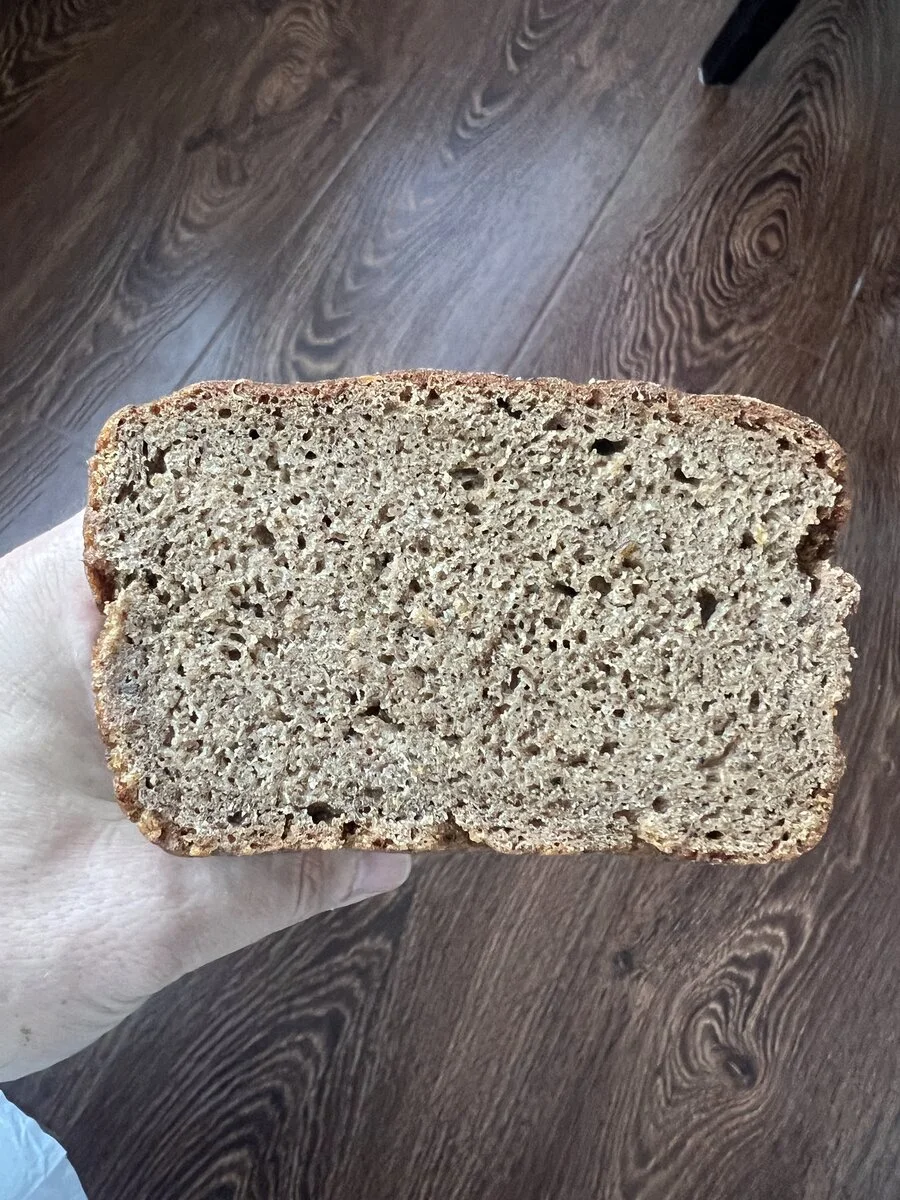
Dense, moist crumb with small even pores — firm enough to slice thin but never gummy after the full 12–24 h rest. The crust is deep mahogany, slightly crisp, then chewy. Flavor opens with earthy whole-rye grain, a clear sourdough tang (brighter with the overnight retard), and a background malt sweetness from the fermented red rye malt. Caraway and coriander weave in as warm spice rather than sharpness. The scald binds water so the crumb stays moist for several days. Some bakers note a faint fruitiness in the aroma; others emphasize the tangy-earthy balance above all.
As described by: The Perfect Loaf — Sourdough 90-Rye Bread , Breadtopia — Lithuanian Black Rye Sourdough Bread
Baking worksheet
Good to know
Why not add another 50–70 g water?
With the current optional 50 g water, hydration is already around 80%, the upper normal range for a loaf with 80% rye flour.
Should this bread rise strongly in the oven?
A pan loaf with a high rye share usually has less oven spring than wheat bread. The key signs are proper proof before baking, no gumminess, and 98–99 °C internal temperature.
Dark bread with 80% rye flour is a high-rye loaf built on a sourdough, a scald, and Brotgewürz (coriander and caraway). Its working formula already includes the scald and spices, so the real questions are about starter strength, acidity, and the proofing point — not about adding more water to a paste that is meant to feel stiff.
How it is baked around the world and why
High-rye dark bread belongs to the cool, damp grain belt that runs across Northern and Eastern Europe, where rye outyields wheat and the baking tradition grew around its quirks rather than against them.
In Germany, this is the world of Roggenmischbrot and near-pure Roggenbrot: a sour rye built on Sauerteig, often with a Brühstück (scald) and a Gewürz of coriander, caraway, fennel, and anise — the exact spice logic used here. German bakers lean on sourdough acidity because rye has almost no usable gluten and its enzymes run wild at neutral pH; the acid keeps starch from being digested into a gummy mess.
In Russia and the Baltics, the same family gives Borodinsky, Darnitsky, and Latvian/Lithuanian rupjmaize: scalded rye, red rye malt for colour and a malty-sweet note, coriander on top, baked dark and dense. The long scald-and-rest method that makes the crumb keep for a week is a direct ancestor of what this recipe does with its 12–24 h rest.
In Scandinavia and Finland, rye runs from soft Danish rugbrød (often with seeds and cracked grain) to Finnish ruisleipä and ruisreikäleipä, the flat ringed loaf. These are eaten as a daily sandwich base — exactly the role this loaf plays best.
Why so consistently dense and dark everywhere: at 80% rye there is no elastic gluten network to trap a light, open crumb, so bakers stopped chasing one. Instead they build flavour and shelf life — acidity from sourdough, bound water from the scald, caramel and colour from malt and a long stepped bake — and bake in a pan, because a paste-like rye dough needs the walls for support. That is why this recipe is a pan loaf with a scald and a stepped bake rather than a free-standing hearth boule.
Theory
High-rye bread does not behave like wheat bread. Acidity, starch, pentosans, scald, bake profile, internal temperature, and crumb rest matter more than gluten development. A stiff paste is normal and does not automatically mean the formula needs more water.
What Changes at 80% Rye
At 80% rye the dough is closer to a paste than to an elastic wheat dough. Gluten development is not the main control. The loaf depends on rye starch, pentosans/arabinoxylans, sourdough acidity, scald, pan support, and a full bake.
The key consequence: a firm paste during mixing is normal. Adding water can make handling easier for a few minutes, but it can also produce a sticky, fragile, slow-setting crumb.
Why the Scald Matters
The scald hydrates rye flour and spices with boiling water. It gives the loaf a more cohesive paste, darker colour, and deeper aroma. It also adds water in a bound form, so the final dough should be judged as a system, not by the last 50 g of water alone.
| Component | Function |
|---|---|
| Rye sourdough | Gas, acidity, enzyme control, flavour |
| Scald | Water binding, aroma, colour, softer bite |
| Malt and spices | Dark flavour profile and aroma |
| Pan | Physical support for paste-like dough |
| Rest after baking | Final crumb stabilization |
Water: when to add it
Add water only if there are dry pockets or the dough cannot become homogeneous. Do not add water only because the paste feels stiff. In high-rye formulas, “stiff” can be normal while “wet” can turn into a weak, gummy slice. With the optional 50 g, hydration already sits near 80% — the top of the working range for this loaf.
If something goes wrong
- Dense, tight crumb → check starter peak, acidity, and proof height before anything else; give more proof and a more active starter, not more water.
- Gummy or sticky slice → bake to a true 98–99 °C internal and wait out the full 12–24 h rest before slicing; cut too early and rye reads gummy even when it is done.
- Bland flavour → mature the starter over more cycles, give the sourdough longer, and check the salt and spice balance.
- Collapsed or sunken top → overproofed or too weak; bake closer to the 1.7–2x point with small cracks, not past it.
Two-stage proof
The 35 °C stage warms the cold dough and restarts fermentation. The room-temperature stage lets the dough finish proofing while the oven heats. The loaf is ready when it reaches about 1.7–2x, with a live surface and small cracks but no collapse.
If it looks ready before the timer, bake it. If the timer is done but the dough is still flat and lifeless, wait and record the delay.
Theory Sources
- King Arthur Baking: 5 tips for making rye bread — practical rye handling and structure.
- Sourdough Bread Quality: Facts and Factors — review of sourdough, acidity, fermentation, and bread quality.
- Arabinoxylans as Functional Food Ingredients: A Review — review of water binding and cereal arabinoxylans.
- Chemistry of bread aroma: A review — review of fermentation, baking, crust, and bread aroma.
Home adaptation
This loaf stays home-feasible because it is baked in a pan. Do not try to handle the paste like a wheat batard. The 35 °C warm-up followed by room-temperature proof is a home method for cold dough, but readiness still comes from volume, small cracks, and surface condition.
A pH meter is useful later, but the minimum controls are an active sourdough, a scald without dry lumps, 98–99 °C internal temperature, and a crumb cut after resting. The worksheet offers two schedules by starter state: “starter already active” runs the whole cycle in one day from a starter at peak, while “from the fridge” adds three refreshments and an overnight sourdough retard for sharper sourness. The cold retard applies to the sourdough, not the final dough, and is optional — drop it for speed, keep it for acidity.
Ingredients
Change any amount — the rest rescale by the bread’s formula.
| Component | Grams | Baker's % |
|---|---|---|
| Whole rye flour | g | 74.96% |
| Wheat flour | g | 18.78% |
| Water | g | 74.78% |
| Refreshed rye starter | g | 12.52% |
| Fermented red rye malt | g | 2.68% |
| Salt | g | 1.97% |
| Ground coriander | g | 0.54% |
| Ground caraway | g | 0.36% |
Preferments, scalds, and old dough are shown as prepared components; their composition is listed in the row details and worksheet.
Ingredient details
Whole rye flour
- Split
- 262 g in sourdough, 105 g in scald, 52 g in final dough
- Brand the author uses
- MukaMuka whole rye (mukamuka.ru)
- Alternatives
- Garnetz whole rye, Chyornyi Khleb rye
Wheat flour
- Brand the author uses
- MukaMuka 13.5% protein (mukamuka.ru)
- Alternatives
- Aleyna Vivapol 12-13%, Makfa premium
Water
- Split
- 210 g in sourdough, 158 g in scald, up to 50 g in final dough
- Important
- a stiff consistency is normal in dough with a high proportion of rye flour and does not automatically mean too little water
- Brand the author uses
- Tap water through Barrier Iron x2 filter
- Alternatives
- any filtered or bottled drinking water
Fermented red rye malt
- Brand the author uses
- Garnetz red rye malt (fermented)
- Alternatives
- TM Bogatyr red rye malt
Salt
- Brand the author uses
- Pink Himalayan salt
- Alternatives
- sea or table salt (avoid iodized)
Ground coriander
- Brand the author uses
- Loose spices, freshly ground
- Alternatives
- any brand of whole coriander
Ground caraway
- Brand the author uses
- Loose spices, freshly ground
- Alternatives
- any brand of whole caraway
Conditions and equipment
Conditions
- Dough type
- high-rye scalded dough at 80% rye flour with spices; a stiff, paste-like consistency is normal and not a sign of too little water
- Pan
- Emile Henry Petit Moule Cake, about 980 ml
- Done temperature
- 98–99 °C internal on 16 Apr 2026
- Crumb evaluation
- not gummy, but dense, firm, with small even pores
- Proof in the 16 Apr bake
- 90 min
Equipment
- Pan
- Emile Henry Petit Moule Cake
- Mixing tool
- Kenwood KVC85.004SI, K-beater on Min; hook not used
- Oven
- Haier HOQ-F6QS, 35 °C proofing phase and stepped bake
- Probe thermometer
- control 98–99 °C internal
Nutrition: dark 80% rye bread
Bread nutrition facts
Per 100 g of bread
192 kcal
protein 5.7 g · fat 1.2 g · carbs 38.9 g
Per slice (50 g)
96 kcal
protein 2.9 g · fat 0.6 g · carbs 19.5 g
Automatic calculation from USDA + Skurikhin database for the baked loaf after evaporation. Numbers are approximate: 1) the database covers ingredients, not finished dough; 2) bake water loss is assumed at 10% — actual loss depends on crust, time, and pan. Add 5–10% in calorie trackers if needed.
This is a dense rye bread with a high share of whole rye, sourdough, malt, and spices. It is usually more filling than white bread, but it works best in thin slices.
- Digestion
- High rye content, acidity, and dense crumb usually slow eating and support longer satiety. A 12–24 hour rest helps the crumb stabilize.
- Helpful or harmful
- Its strengths are whole rye, fermentation, and spices without sweet enrichment. The limit is density: large portions can feel heavy.
- Amount
- Start with 1–2 thin slices, about 30–70 g, ideally with protein and vegetables.
- Best pairings
- Pair with fish, eggs, cottage cheese, cheese, vegetables, herbs, soups, and fermented foods. Butter, fatty fish, and cheese taste good but raise the meal energy quickly.
How to eat
- Do not slice or judge rye bread hot; the crumb needs post-bake maturation.
- For a lighter daily version, use thinner slices or a 60/40 formula rather than adding sweetness.
Limits
- Contains gluten and may feel heavy for sensitive digestion.
- If limiting sodium, remember bread can be a regular sodium source.
Instructions
-
Refresh the starter
Run the 1:2:2 → 1:3:3 → 1:4:4 sequence (in grams: 10+20+20 → 8+24+24 → 10+40+40) and use the final refreshment at peak.
-
Build sourdough
Mix 262 g rye flour, 210 g water, and 70 g refreshed starter; keep 4 h at room temperature, then refrigerate overnight.
-
Make the scald
Pour 158 g boiling water over 105 g rye flour with coriander and caraway, mix, and keep covered to cool; in the three-refreshment schedule, refrigerate it overnight together with the sourdough.
-
Mix final dough
Combine sourdough, scald, final flour, malt, salt, and up to 50 g water; mix to homogeneity only.
-
Proof
Proof first at 35 °C, then at room temperature until 1.7–2x and small surface cracks.
-
Bake and mature
Bake stepwise to 98 °C internal and rest at least 12 h before slicing.
Version history
Show version history
- v3.9June 1, 2026
- Problem
- The worksheet only covered waking a fridge starter with three refreshments, and the evening mode mathematically pushed the sourdough build and second refreshment to 03:00–05:00. There was no ready schedule for starting from an already-active starter.
- Change
- The worksheet now has two modes. "Starter already active" — start straight from the sourdough, the whole cycle in one day, no retard (for when you have 70 g of starter at peak). "From the fridge (3 refreshments)" — the former full cycle with convenient daytime hours and an overnight sourdough retard. The broken evening mode with overnight steps was removed.
- Result
- In both modes all active steps fall within 07:00–22:00; only the passive sourdough retard or the loaf rest occupy the night.
- Conclusion
- The cold retard here is a sourdough retard, not a final-dough retard, and it is optional: drop it for speed when the starter is active, keep it for acidity when starting from the fridge.
- v3.8May 24, 2026
- Problem
- The three-stage rye starter refreshment schedule did not show the individual stage durations clearly.
- Change
- Added explicit refreshment durations and a separate second-refreshment window so the worksheet shows the schedule directly.
- Result
- The dark 80% rye worksheet now reads consistently across Russian and English.
- Conclusion
- Starter state still matters more than the clock, but the worksheet should show expected intervals without ambiguity.
- v3.7May 8, 2026
- Problem
- The English high-rye lesson needed stronger theory and clearer diagnostics.
- Change
- Added sections on 80% rye behavior, scald function, water decisions, two-stage proofing, and theory sources.
- Result
- R1-C2 now explains why density is not fixed by water alone.
- Conclusion
- Before adding water, check starter strength, acidity, proofing, internal temperature, and rested crumb.
- v3.6April 30, 2026
- Problem
- The modern-method review found that the high-rye lesson needed home controls and diagnostic questions.
- Change
- Added home adaptation for pan baking, two-stage proofing, scald handling, probe temperature, and rested-crumb assessment.
- Result
- R1-C2 now separates normal high-rye density from fermentation, proofing, and bake errors.
- Conclusion
- Do not increase water before checking starter strength, proofing, internal temperature, and rested crumb.
- v3.5April 30, 2026
- Problem
- The English page was not explicitly framed as an R1 high-rye lesson.
- Change
- Added R1-C2 course framing, rye theory, sensory checks, and the course-map link.
- Result
- The page now reads as a lesson, not only as a working formula.
- Conclusion
- The next bake should test starter strength and proofing point, not a large water increase.
- v3.4April 22, 2026
- Change
- Proofing rewritten as a 35 °C warm-up phase followed by room-temperature proof while the oven preheats.
- Conclusion
- The next bake should test whether the updated proofing gives a less firm crumb without excess water.
- v3.3April 16, 2026
- Problem
- The loaf was not gummy, but was dense, firm, and slightly bland.
- Change
- Single variable change: proofing from 60 min to 90–110 min.